Saturday, August 08, 2009

Fairhope, A Storybook Town

It has come to my attention that Fairhope is billed in the promotional literature as a “Storybook Town.” It has also been called such things as a “little Norman Rockwell town,” and a “Disneyland town.”

Aargh. I am doing what I can, by harping on the subject of Fairhope history on this blog, to keep it from becoming any of those things.

When I first moved back in 1988, there actually were some remnants of Norman Rockwell cottages, little houses that had been built between the two World Wars -- modest houses that looked as if nice families lived there. Fairhope had an undiscovered quality that I would hardly have called “storybook” in the sense of the charming little Tudor homes of California or the New England farm houses, or the Midwestern carpenter gothics of the 1800’s. It was almost unreal in its quietness. The last of the fabled hotels of the town, The Colonial Inn, stood decrepit in its prime spot overlooking the bay, all but abandoned, awaiting the wrecker's ball.

There was very little to do on a Saturday night. There were a few eateries, but only one really nice one, a remodeled old farmhouse out behind the new shopping center, known as Dusty's. It was owned by a local character who had had a career as a cocktail pianist and had a young, creative wife who put the restaurant on the map, thereby giving parched little Fairhope a first-class place to take visitors or a special date.

A novel had been published in 1959, written by a young man named Robert E. Bell, who had been so entranced by what he called the magic of Fairhope, that he set his story in a fictionized version of the town, renaming it Moss Bayou, and smothering the setting with such phrases as "Somewhere after a turn down the street, he saw a glimmer of water, gold-flaked through the trees; the frond-dragging palms bent with the curve of the road which heat-danced ahead of him, charging the sky with its electrical glare." The title of the book was The Butterfly Tree, and it was not the last book to drench Fairhope in the mysteries of the imagination of an outsider.

An insider, I worked with Bob many years later on a book that I hoped would present a more realistic picture of the Fairhope I knew, incorporating his lyrical prose describing a town projected from his memories with my own workaday knowledge of what it was like to grow up in the little enclave that I found neither magical nor romantic. The book we collaborated on reflected two sensibilities and embraced Fairhope from two sides. Its title was Meet Me at the Butterfly Tree, and if you've read much of this blog or if you click on the link, you'll know almost all there is to know about it short of actually reading it.
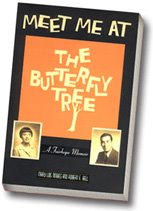
Both those books may have contributed to the myth that Fairhope was some kind of ethereal, enchanted locale, a Brigadoon that only appeared in the line of vision of the fortunate few. Charming as that image might be, it simply isn't true. My second book, The Fair Hope of Heaven/A Hundred Years After Utopia, seeks to dispell the mythology as much as possible.

Fairhope was a very real town, founded on the principle of providing economic parity, especially in housing. Land was available on a 99-year lease basis, with a low “rent” or tax, to be paid to the Colony yearly, to be determined by what would be considered fair market value. Each family could build what it could afford on the land leased from the Colony. Little houses were built by the impecunious couples who wanted to participate in the Utopian experiment known as the Single Tax Colony, and these houses were expanded room by room as the families grew. That is why so many of the early cottages had small rooms and lots of them. Those little affordable abodes grew with the families that inhabited them.

The Single Tax experiment could hardly be called a rousing success, especially after the Federal Government established an income tax on all citizens in 1913. It was a sound principle that eventually was proved wildly impractical, perhaps especially in Fairhope, the town that was created in order to prove the opposite. Apparently greed is human nature, and the selflessness required to ensure cooperative individualism -- the term used by E.B. Gaston, Fairhope's founder to describe his ideal economy -- was soon overshadowed by the wave of opportunists who learned how to exploit the very land he fought to preserve.

If Fairhope is a storybook town, the story has been rewritten too many times to be of much consequence. Even the historical cottages, for the most part, have been demolished and replaced by monuments to the prosperity of their owners -- huge, ostentatious houses that compete with each other for attention and blur the landscape that was once authentic, meaningful and charming in spite of itself. That it is still a storybook town is the greatest fiction of all.

Wednesday, June 03, 2009

Before Fairhope Was Precious

I've written a lot about my memories of Fairhope, both on this blog and in two books. I lived there as a child and again when I moved back in 1988 until I left for good in December of 2007.

Others are compelled to write about Fairhope too--from Sonny Brewer with his lyrical The Poet of Tolstoy Park to Rick Bragg in the current issue of Smithsonian Magazine.

It is Bragg's latest that inspires this post. He is, like many of us, somewhat conflicted about Fairhope. He writes that he loves the bay, the surrounding geography of what is now Fairhope, but that he finds it "too precious" to be a comfortable place to live. It's a tourist town now, and an extension of Mobile, and his article, which you can read here and post a comment on if you wish, has generated much response across the board. There are those who love Fairhope and think Bragg got it right, others who love Fairhope and think he didn't, and those who just love everything Rick Bragg writes and don't know anything about Fairhope.

If you want to read some about old Fairhope, you can find a post on this blog "In Praise of Old Libraries," or one with a picture of the Christian Church, one of the first structures in town, or one about the corner of Fairhope Avenue and Section Street, which I call "The Center of the Universe."

There was a time when I thought I'd live out my days in Fairhope. But life has its way of changing, and the time came when I didn't want to live there another day.

But I still love to visit, and I still cherish all the memories I have of when it was simpler and less self-conscious, less precious--simply an extraordinary little town peopled with unusual, special, thinking folks. I recommend that Fairhope. You'll find it in the writings of those who knew it long ago, including myself in Meet Me at The Butterfly Tree and The Fair Hope of Heaven. Newcomers and visiting luminaries tend to write about the little city as if it held the answer to all questions, the fount of all wisdom, and as if it is the magical Norman Rockwell town they've always dreamed about. Fairhope has a great many pleasant qualities and a few drawbacks. It is in transition now from a haven for intellectuals to some new incarnation, but it is situated in one of the most beautiful spots you'll find. Just don't expect too much. There is more to Fairhope than meets the eye, but it isn't all pretty.

Saturday, May 30, 2009

Real Life and Real Estate

There's a house for sale in Fairhopeland, Montrose to be exact. Practically the last historic house standing in what used to be a quiet, mysterious village on the Eastern Shore, rife with stories about days dating to the early Spanish explorers. This example of Creole Cottage architecture was built from timbers and on the foundation of an early Catholic church and has housed many a complex and happy family, including Morris Timbes and his adorable wife and delightful and brilliant children (one of whom was me). Today the bids are flying, and the house is coveted by at least one delightful family with hopes of someday occupying it. Don't these endearing people just touch your heart? Don't you wish every story in real life had a happy ending?

Thursday, April 30, 2009

The Latest News of the Fair Hope of Heaven

Don Noble, Alabama's premier book reviewer, wrote some very nice words about my book The Fair Hope of Heaven/A Hundred Years after Utopia. His review, which was aired on Alabama Public Radio, can be read at this link. Click on the blue letters and read what the nice man said.

I love Don's thoughtful interviews on Alabama Public Television, and am angling for an appearance next time I'm in the state. Right now it looks as if that will be October. Whether I get a booking on the show remains to be seen. Watch this space for further information. In the meantime, go to amazon.com or Barnes and Noble.com or go to Page and Palette in Fairhope and buy the book.

Also, this was published in John Sledge's book column in the Mobile Press-Register on Sunday: "...Mary Lois Timbes is also inspired by memories of growing up in a simpler time and place. In The Fair Hope of Heaven, she has expanded and updated her earlier reminiscence of Fairhope, Meet Me at the Butterfly Tree. Her new effort features more stories and more characters. 'All little towns of the late 1940s an early 1950s were simpler and more nurturing than they are today,' she writes, but this particular one had a history of and until recent years retained a faint whiff of the bohemian.'

"Included in this delightful volume are portraits of such Fairhope icons as Ernest Berry Gaston (the founder), Marietta Johnson (of Organic School fame), Winifred Duncan (author of Webs in the Wind, a book about spiders) and Craig Sheldon (sculptor). Also highlighted are the bayside burg's more quirky facets, like the nudist colony that once flourished around 1910.

"Despite all the changes since Timbes' youth, Fairhope's magnificent natural situation remains impressive, and she gives it due coverage. The modest architecture and colorful, outsized personalities have mostly gone, but the sweeping bay views, dramatic gullies and warm evenings remain constant, and continue to draw visitors and new residents from far and wide. 'Fairhope may have changed as the world has changed,' Timbes concludes, 'yet it retains remnants of Utopia at its heart.'"

I've posted a great deal about the book on this blog, so if you want a taste, browse the blog. You can read more reviews here, and once you've read the book, you might post a review of it yourself!

Wednesday, March 11, 2009

Education Reform? It Started in Fairhope


President Obama is committed to a deep reform of the educational system. I hope while investigating options his experts will take a look at what they call in Fairhope the Organic School.

Founded in 1907 by visionary educator Marietta Johnson, the Organic School was based on the same kind of reform that Fairhope itself was, and it fit in the little village like a glove. It was to work hand-in-hand with the Single Tax Corporation for its first years of existence, and the two institutions shared many of the same benefactors and local support.

The principles of Organic education remain radical. The basic premise is that education is natural to life (Mrs. Johnson used to say that education is life), and that children's curiosity and love of learning is to be incorporated in the process of teaching. She wrote two books on the subject which are incorporated into a slim volume called Teaching Without Failure now for sale at the Marietta Johnson Museum.

That's a daunting title. Perhaps the most difficult aspect of her system was that Mrs. Johnson believed that no child should be allowed to "fail" at education. The concept of failure was turned on its head; if the student didn't grasp the subject, it was failure of the school rather than the child. She solved this dilemma by simply eliminating measurements from the equation.

How, then, said the education Establishment, are we to know what a child is learning? The answer is that "we" don't. Any child can cram facts and pass a test, but has he really learned? Only the student in question is capable of knowing how much he has learned. In today's obsession with test scores, this is the most difficult aspect of Organic education to sell to the public.

Today, many of Mrs. Johnson's tenets have been softened at the school. It was essential to her system that students begin at the earliest year possible and remain in the school through high school. If an unfortunate child had to transfer, he had a big adjustment to make to adapt to the atmosphere of adversity in a traditional school, but soon emerged victorious, having been imbued with a basic love of the learning process. Now it is seldom that a student remains in a school from kindergarten through high school. The Organic School itself goes only through the eighth grade at this point.

But there is much to be learned from the school, which Mrs. Johnson considered a demonstration of the direction for all education. When traveling in Progressive Education circles, she was often challenged about her idea of education. "It sounds lovely," she was told, "But it could never work."

"Come to Fairhope and see," was what she answered. Many did, and many took away ideas which have become part of the schools of today.

There is a lot written about this unique approach to education reform. Read my books about it, which are at Page and Palette Bookstore in Fairhope or at amazon.com or Barnes and Noble.com, or drop by the Marietta Johnson Museum on the Faulkner campus for information about Mrs. Johnson and the school, or go to the campus on Pecan Ave. east of Section Street.

Or look it all up on the Internet!

Wednesday, February 18, 2009

A Look at Fairhope, Bare Feet, and Heaven

February 18, 2009

Rupert Schmitt, a friend who spent a night or two in my garage during the 100th Reunion of the Marietta Johnson School of Organic Education, wrote this as kind of a review of The Fair Hope of Heaven:

"Mary Lois Timbes is a skilled biographer.

"Upton Sinclair, the author of The Jungle lived in a cottage on the beach. He served raw food banquets. The Jungle exposed the meat packing industry and caused the passage of the meat inspection act. Today we need a peanut butter inspection act.

"Clarence Darrow visited the town two years after the Scopes Trial debated evolution in Dayton Tennessee. Imagine a trial with cheering and jeering.

"One lady, Emma Schramm had the freedom to live in a tree house 12 feet off the ground.

"The Fair Hope of Heaven reminds me of a place where students had the freedom to go bare footed to school. One boy, Paul Gaston, now a professor, went barefooted for an entire year. The Organic School principal John Campbell had the freedom to stand on his head. The Organic School, founded the same year as the Montessori School, emphasized students. Marietta Johnson would spin in her grave upon hearing of today’s educational values. Her school acted Greek Myths during hikes to gullies. Her students climbed trees while barefoot. Required classes included folk dancing, music, and arts and crafts. The children enjoyed school. 'Her school did not grade its children or have periodic tests or examinations.' John Dewey visited the school. A chapter in Schools of Tomorrow covered the Organic School.

"Fairhope was developed in Alabama by single tax Utopians from Iowa. The town was a magnet for free thinkers including Sherwood Anderson who some years later introduced Gertrude Stein in Paris to Ernest Hemingway. Northern liberals, including my father, stayed in the Colonial Inn while vacationing in Fairhope.

"Not all of the people espoused complete freedom. Bill Edwards, one of the teachers, never spanked his children: 'Punishment for their infractions was that they would be required to run up and down the stairs twice.' His students in woodshop built a 36-foot ketch. 'They had to tear a wall out of the Arts and Crafts Building to extract it and take it to the bay for a trial run.' After the stock market crashed, Bill moved his family to the U.S.S.R. Disillusioned, he returned to the U.S. in 1935.

"The Organic School is still open for business, however because of liability issues, the students of today must wear shoes."

Rupert's comments give only a taste of the many stories you'll find in The Fair Hope of Heaven. Willard Edwards, the chap who moved to Stalin's Russia, had much more impact than the building of the Osprey or the move to and from Russia--and there are other characters, including Blanche Brown and Dian Arnold, Gretchen Riggs, Verda Horne, and the ubiquitous Craig Sheldon in the book.

I hope more of its readers will respond here and tell us their favorite stories from old Fairhope. If you don't have stories of your own, you're sure to find many in The Fair Hope of Heaven!

Monday, February 09, 2009

The Fair Hope of Heaven--Reviews Trickle in

February 9, 2009

Reviews for my new book The Fair Hope of Heaven/A Hundred Years After Utopia have begun to trickle in on amazon.com

See for yourself:

Some dreams are realistic, some are utopian. I would almost put in the latter category my dream of someday writing a book with the exquisite timing of this one. One day, we find ourselves living in the very prototype of an advanced capitalist society; a few months later, Newsweek adorns its cover with the inscription, “We Are All Socialists Now.” And indeed, that "S" word is now on everyone's lips. But when you read Mary Lois Timbes’ newest work on Fairhope, Alabama, you might not use the word socialist quite so glibly. This is a charming, breezy read about a town founded roughly a century ago on the belief in the idea of Henry George, who believed that land is the only commodity that should be taxed at all, and all citizens should share equitably in the fruits of those taxes.
Yet, as Ms. Timbes tell us, Fairhope was not socialist. It was, in fact, the model of an individualistic society in the sense of celebrating the diversity and accepting the eccentricities of its residents—the kind of characters who typically would be ostracized in small towns and lost in big ones.

Reading about Fairhope would be a delightful experience at any time, but it is especially valuable now, when we are all questioning some of the assumptions upon which our social and economic thinking has been based. Get ready to experience a place where you probably wished you could live, but never imagined existed. You?ll revel in the outstanding accomplishments of its residents of yesteryear and wonder why its current residents haven't been interested in returning the town to the glories of its past. Perhaps after reading this book, they just might.
This was written by Washington D.C. attorney, blogger and author Dan Spiro.

Dr. Paul M. Gaston, author of a number of books about Fairhope, writes:
With insight and sensitivity, Mary Lois Timbes recalls and reveals the Fairhope utopian colony as it once was and has become. The biographical sketches of some of the colony's unique characters will delight those who knew them and attract those who meet them here for the first time.

This from Perdita Buchan, a writer and teacher of writing, whose own book Utopia, New Jersey, inspired me to get back to writing this, my latest opus:
The Fair Hope of Heaven is a charming evocation of the town on Mobile Bay that began as a utopian experiment - and of the many unusual and appealing characters who made it their home from its beginning in 1894 to the present. Eccentric they may have been, but they lived lives valuable to themselves and the community. And it is valuable to have them remembered.


I'm told by John Sledge that there will be a review of the book in the Mobile Press-Register as well. If you want to find out about the book first hand, it's for sale in Fairhope's Page and Palette bookstore.

Sunday, January 04, 2009

Upton Sinclair, from The Fair Hope of Heaven

January 15, 2008

Upton Sinclair moved to a cottage on the beach in Fairhope in 1909. He was a famous novelist at the time, having written The Jungle three years earlier. I have a chapter on Sinclair in The Fair Hope of Heaven. Sinclair was a man looking for the perfect place to live, and for a time he tried Fairhope.

Most of us remember the name Sinclair Lewis from American Lit classes in college, but this is the other Sinclair. Anthony Arthur said that Upton Sinclair once remarked, “Maybe we should just both take the name Upton Sinclair Lewis.”

Upton Sinclair was a Socialist, an idealist, a food faddist, and a complex and interesting man who wrote books whenever he felt the world’s ills needed correcting, which meant that he wrote books constantly. He lived during a period in which like-minded idealists banded together, often in colonies, not unlike our own Utopian Fairhope. After camping in inadequate shacks since their marriage, with money from The Jungle Sinclair and his wife Meta had bought an old private school building on the Palisades in New Jersey to house the artists’ colony that was his dream. He called the project Helicon Home Colony, after the Greek muse of the arts, Helicon. John Dewey, also a figure in Fairhope, visited his colony and even the young Sinclair Lewis, a Yale student, helped out with janitorial duties.

Helicon Home Colony burned in 1907, and with it went Sinclair’s hopes for his own personal ideal world. From there he traveled with wife and baby David to Carmel, where he experimented with health foods and wrote books and plays intended to convert mankind to his two pet causes: health diets and Socialism. He wrote books about raw food diets, fasting, vegetarianism. He and his family were to spend time in Battle Creek at Kellogg’s and health guru Bernarr MacFadden’s establishments, and other such enclaves, before they moved to Fairhope to try it out.

Raised by a puritan mother and an alcoholic father, Sinclair early on thought of himself as a genius. His personal heroes were Shelley, Hamlet, and Jesus Christ. He was convinced that he was ordained to write the Great American Novel, and he made at least 60 attempts at it, most of which sold very well and had literary merit while succeeding best at presenting his latest propaganda soapbox.

As a Socialist, he would have been well-acquainted with the Single Taxers, and Fairhope had a strong attraction to those who sought a heaven on earth, as many did in those days. Young David, well-read in the books of his parents’ choosing, was getting old enough for school, and the Sinclairs probably saw the need for some life with other children. David Sinclair became one of the first children enrolled in the Marietta Johnson School of Organic Education.

In his 1932 autobiography, Sinclair wrote: “For the winter (1909-10) I took my family to the single tax colony at Fairhope, Alabama, on Mobile Bay. Since I couldn’t have a colony of my own, I would try other people’s. Here were two or three hundren assorted reformers, having organized their affairs according to the gospel of Henry George; trying to eke a living from poor soil, and feeling certain they were setting an example to the rest of the world. The climate permitted the outdoor life, and we found a cottage for rent on the bay-front, remote from the village.

“…I was overworking again; and when my recalcitrant stomach made too much trouble, I would take another fast for a day, three days, a week. I was trying the raw food died, and failing, as before. I was now a full-fledged physical culturist, following a Spartan regime. In front of our house ran a long pier, out to the deep water of the bay. Often the boards of this peir were covered with frost, very stimulating to the far feet, and whipped by icy winds, stimulating to the skin; each morning I made a swim in this bay a part of my law.”

In The Fair Hope of Heaven I have included some lovely diary entries by the young bride of Sinclair’s secretary – Dave Howatt, also a raw-food advocate – describing the scene in Fairhope of those halcyon, idealistic days. These pages deserve a blog post of their own, offering an enchanting portrait of a young woman in love in another era, in a bayside village that is long gone.

The marriage between Upton and Meta Sinclair, unlike the Howatts', was not to last much longer. Meta's physical passion had been more than he bargained for, and he sought to quell it in any way he could, at last inviting her to bring her young lover, Alfred Kuttner, to join them in Fairhope, where such liaisons were not unheard of. It was in Fairhope that Sinclair wrote his autobiographical work, Love’s Pilgrimage, allowing Meta to pen the portions concerning Corydon, the female protagonist.

Probably the member of the Sinclair family to benefit most from his brief time in Fairhope was David, who was enrolled in the Organic School, and loved the life out of doors, later becoming a scientist and probably early on imbued with the free spirit of Fairhope in those days. There is a charming excerpt from Sinclair's description of himself and David sleeping on the outdoor porch of their beach cottage. I'll leave it to you to find the description yourself in the book.

The Fairhope to which Upton Sinclair repaired a century ago is a very different one from the one you'll find today. Most of the beach cottages have been replaced by large, imposing and impressive multi-million-dollar homes. People no longer move to town for escape from the tribulations of modern life, or for the intellectual pursuits in planning a better world. But they move there because they love its possibilities, still. They want the best place they can find, and they very often find it in Fairhope.

The Fair Hope of Heaven can be found at Page & Palette Bookstore in Fairhope, on amazon.com or on my website.

Wednesday, December 17, 2008

Plot of the New Book Thickens

December 17, 2008
I posted here a few months about about the publication of my new book, the one you see pictured. I was excited to have completed it--I thought in time for Christmas publication--and expected to be in Fairhope early in November for booksignings.

Things do not always go as expected. There was a snag somewhere. I had misunderstood the publisher's timeline. Or just maybe they had misunderestimated their own ability to get the thing in print fast. I'm now expecting to have a book in my hand in early January, and to be signing copies of it at Page & Palette January 24 from 2-4 P.M. Thicker than the first book, it will be hard cover, and will retail for about $25.

The Fair Hope of Heaven is similar to Meet Me at the Butterfly Tree. It has some of the same chapters--most expanded to include more information--and a lot of new ones. It deals with the history of Fairhope, with chapters about Clarence Darrow and Upton Sinclair, along with some about other interesting Fairhope characters like Dian Stitt Arnold who rode horses and raised six children and always wore miniskirts and cowboy boots and Willard Edwards who moved his family to Stalin's Russia during the Great Depression, finding Fairhope not Socialistic enough.

I'll get the publicity out, am putting together a new website, and will be seeing you at the bookstore. Update: The Fair Hope of Heaven is available at amazon.com or on my website.

Friday, December 05, 2008

The Man in My Garage II

December 5, 2008

Before I left Fairhope I participated in the 100th anniversary reunion of the Marietta Johnson School of Organic Education, one of the city's venerable and venerated institutions. People flocked to town from all over the country to celebrate the lives they had lived and thank the school itself for all the possibilities that had been opened for them.

I obliged one of them, Rupert Schmitt, by putting him up in the spare room in my garage. At the recent reunion of the Marietta Johnson School of Organic Education, a.k.a. The Organic School, people came into Fairhope from all over. I expected to have a couple sharing one of the little bedrooms upstairs in my cottage, a student teacher in the other, and a man living in the little room at the back of the garage for the duration. The only one who could make it was Rupert.

Playing hostess to him as well as partaking of all the events of the reunion weekend and giving something of a lecture at one of them (plus reading a chapter from Meet Me at the Butterfly Tree at another) gave an offbeat dimension to my participation in the proceedings.

He turned out to be in some ways typical as a product of our unconventional school, but for the main part, a man like no other. He likes to go which ever way the wind blows him, and this has taken his windblown persona in many directions. A delightful raconteur and observer of details, he carried big blank notebooks with him wherever he went, asked questions of everybody, and wrote down almost every damn thing anybody said. He was quick with a quip, but quizzical about many of the answers he got. I had a wonderful time with him.

Now Rupert has published a book of poetry called The Interview. I commend it to you. Written by an observer of animals and nature, it has cat poems, bird poems, leaf poems, and poems about his family and his outlook on life.

As a writer, Rupert is whimsical, tangential, and utterly charming. He captures many facets of a life lived for its own sake, full of love and the adventure of small events and odd creatures. He looks at the world with wonder, humor, and sometimes anger. He is always original, not always 100 per cent satisfying -- but always delicious. The book can be ordered from amazon.com or iUniverse.com. I searched for a Fairhope poem but found none, unless you count the overarching old-Fairhope tenet that nature is nearby and it is our fairest hope to do our best by it, a mood which pervades all the poems in his book. I'd like to think Rupert learned some of that at the Organic School.

Saturday, August 09, 2008

A (Fairhope) Book Is Born

August 9, 2008

This blog was created to draw attention to a book I'd written about Fairhope which I thought related to the world at large. Meet Me at the Butterfly Tree was just printed and I'd put up a website to promote it. A few visit the web page every day, and even now a few come here having seen it. If you haven't yet visited the site, all you have to do is click on those blue words and read more about me and my book than you ever dreamed you wanted to know.

Although this blog came to discuss life in general, philosophy, art, love, and the afterlife, I still plug the book from time to time, and spend what time I do here writing about the Fairhope in my mind. My own life is unfolding its chapters in Hoboken, New Jersey, and I have a very active blog detailing my adventures there. Check it out!

In the meantime, also mentioned at length on this blog, I had written a second book about Fairhope called When We Had the Sky. Where Meet Me at the Butterfly Tree was a memoir of people I'd known in the 1950s in Fairhope, When We Had the Sky goes back in time to chronicle the Fairhope's founding days in which its visitors included Clarence Darrow and Upton Sinclair. It expands the first book and continues with memorabilia from Fairhope's past.

Not able to find a publisher for When We Had the Sky (it got super rejection notices from the University of Alabama Press and River City Publishing -- both suggesting it was an excellent book but that there would not be enough of a market for "another book about Fairhope" for them to put money into printing it) I let it go for a couple of years.

Then I moved to New Jersey and read a book called Utopia, New Jersey, which inspired me to combine the two books and put the story of Fairhope into the context of the spate of utopian communities that spawned it. I omitted the contributions of Robert E. Bell, who collaborated on Meet Me at the Butterfly Tree, wrote a new chapter on the Fairhope's utopian origins, and selected a few of the favorite other character sketches, put it together with When We Had the Sky, and have come up with a NEW BOOK.

I'm working with an online publisher with whom I'm working to get the book for sale in store -- and online, of course -- in time for Christmas.

Watch the Fairhope papers, y'all, for news of the new book. It will be entitled The Fair Hope of Heaven/A Hundred Years after Utopia, and will be bigger and far better than the sum of its parts, which is to say better than either of the other books. I guess it won't be better than both, but it will be better than either.

I'll be in Fairhope to hold booksignings, I hope in November. I look forward to seeing you then.

Tuesday, July 01, 2008

The Captain's House Has New Owners

July 1, 2008

Yesterday the deed was done; numerous papers were signed, a check was signed and handed across the table (and deposited in the bank), and it's official. The house in Fairhope is no longer mine.

I live in Hoboken, New Jersey, for real.

It's a good feeling to be free of the worry that I may be paying taxes and various bills on that house for years to come. It's an even better feeling to have met the new owners and to have found them to be parents of three small children. They have plans to add a bathroom, which the house sorely needed, and to remodel the interior to suit their needs -- but they truly love what the house is and was and they know it's in the ideal location for Fairhope. They'll get to view the fireworks from there on the 4th (or at least to walk down the hill to the bluff and not have to drive around looking for a parkin space). They'll be able to walk their daughter to the K1 Center when she starts kindergarten in the fall. They'll allow their children to play outside without fear of traffic or kidnappers.

And I'll live in Hoboken, for real.

Saturday, June 21, 2008

Finding My Way to Fair Hope

June 21, 2008

Look out, Fairhope! I'm coming back for a week!

Wednesday afternoon I should be back in Fairhope; the captain's house has been sold, and I'm gonna be at the closing on June 30.

I decided to give myself a week to look around, check out old friends, and maybe even say goodbye. I have been away for seven months and with the sale of the house I can leave with impunity. In fact, I've already left with impugnity, but this trip offers me an almost final look around.

Notice how I said almost final? I have family in the place, and I've just completed a book about Fairhope, so there seems to be no end to it.

I published Meet Me at the Butterfly Tree in 2001, reprinted it in 2005, and finished a second book which I called When We Had the Sky -- also about Fairhope in the past -- and couldn't find a publisher. Reading a book called Utopia, New Jersey inspired me to rework both books, combining the two and adding more historical information about Fairhope's history as a utopian community.

I'll bring along a copy and see if it flies in Fairhope. Maybe I can find sponsors to pay for the publishing, and, if that happens, I'll be back in Fairhope many times to promote the book.

Maybe I'll see you in Fairhope this trip, or the next, or the next. Look for me.

Monday, April 07, 2008

Brad Pitt in Fairhope

April 7, 2008

A noticeable spike in readership of this blog Friday revealed that the attendants all used the search words "Brad Pitt in Fairhope."

I once posted on a mythical remake of Gone With the Wind, suggesting Pitt as a candidate for the role of Ashley Wilkes. I still think that's a pretty good idea. That mention of the actor was the only reason for those seeking information about Brad Pitt -- and possibly Angelina Jolie as well -- in Fairhope last week visited this blog.

Not knowing anything about whether or not the couple actually came to Fairhope (and not living anywhere near there any more) I made contact with a few who might know. Two out of three had heard nothing about it, but the third wrote, "Yes, he's here for the first Fairhope Film Festival and the rumor must be true, but I haven't seen the dude, but maybe I'll drop in on tonight's movie. He is probably here because the festival showed "Forgotten Coast" this afternoon at USABC, so, it's not really much of a stretch for him to come over from N.O. where he has a pad out on St. Charles."

Later the press got into the picture. Reporters sought out Pitt by following the leads they had gotten from others, but nobody had seen him.

If you came because you thought you'd learn more about Brad Pitt in Fairhope, I hate to disappoint you. If you know something I don't, please make a comment and enlighten me and my readers.

Wednesday, February 13, 2008

And a New Reader Sends Me a Valentine


February 13, 2008

Received this picture with a message attached from a reader who used to live in Fairhope and has bought a copy of my book. Message: "had to put the book down and take a sip.
'ghosts constantly confront me in fairhope'
more later..."

Ah, yes.

Friday, November 16, 2007

Fair Hope for the Clueless Blogger

November 16, 2007

Yesterday I created a new blog and today I find a lot of stuff intended for the old blog changed on this blog. If you're confused, join the crowd! I thought I was creating a profile referencing my Hoboken persona, only for the Hoboken blog but here it is, all over this one. I dunno if there's any way my different blogs can have different profiles, but if not, the Finding Fair Hope of the past will merge with the Stranger in the Night future, and the world will just have to figure it all out.

The blogger site doesn't seem to know how to. Or maybe it's just me, the blogger. Patience is a virtue, I'm told.

Thursday, November 15, 2007

Finding a Place to Blog

November 15, 2007

I've done it, friends! I've created yet another blog the world has been waiting for...or at least a few people in the vicinity of Hoboken, New Jersey, who may be wondering what all this flap about the new blogger in town is all about.

You can get there by going to Finding Myself in Hoboken which I launched today, having nothing else to do but pack up a lifetime of belongings and clean up and move from here.

Check it out, and bookmark the page. There will be less and less on this one in days to come.

Friday, November 09, 2007

The Biography of a Blog

November 9, 2007

This blog was born early in 2006, at a time when I had a new toy -- a Mac laptop. A friend mentioned that Apple had informed him the new machines had blog capability, and I knew writing a blog would be duck soup for me.

I contacted another friend who lived in faraway Virginia and I knew to be pretty good with computers. He went to the Blogger home page and walked me through the process, starting his own blog (mendacious mouse) at the same time. For a period of about six months in 2006 the interaction between our two blogs kept us both afloat. At that time this blog became reflective and philosophical, and I aired my views about the meaning of life and the existence of God, right upside the movie reviews and what is known as entertainment trivia (but to me is a mainstay of life as I know it). I had notified a list of friends about the existence of this blog, and many, including artist John ("John Sweden") frequented both blogs and stirred up controversy as he educated us all about the many faces of art.

But Finding Fair Hope had been designed as a vehicle to sell my book Meet Me at the Butterfly Tree and my constant references to the book and to the town of Fairhope in which I had grown up were really not particularly helpful to sales of the book. I wrote about the book less and less, even as I posted daily on the blog until November of 2006.

Along about that time I became tired of the daily posts. I decided the blog itself was sapping my time and energy, and posted that I would cease the blog. Yet every few days I was inspired to post, and post I did. I never went back to once a day, but I was posting at least three times a week after I had announced that the blog was dead. My friends John Sweden and the blog-mentor "benedict s." began posting comments less frequently. Finding Fair Hope became the one-person wank job that a blog has a tendency to be. I know those are strong words, and in fact I'm rather proud of what I've written here, but I must admit that when you're writing just to expose your inner thoughts on myriad topics, you can get, shall I say, self-indulgent.

I still think this is an extraordinary place to browse. I do it myself sometimes. Just click on any post listed at the left, or on any given month in the past, and scroll down to topics you find intriguing. It's pretty damn good, if I do say so myself. The author has an interesting, quirky voice, and a wellspring of opinions.

Shall I continue this blog after I am no longer finding fair hope in Fairhope? Not quite. I have thought about it a lot lately, as I sort, pack and discard the detritus of my life for a move. But it becomes clear to me that I'll blog again.

I could rename this blog. A reader suggested the clever "Finding Fair Hoboken," which makes me smile just as this lovely person does when I think of her. But I've decided I'll create a blog called Finding Myself in Hoboken, describing the adjustments I must make in a new environment, the surroundings of Hoboken itself, and the changes in my life as I go forward.

I could just rename the blog and keep the address, but I think I'll find a way to make the address closer to the new blog title. I'd like to keep all the works here on the new blog, and if I figure out a way to do that I'll let you know.

There are not only second acts in American life, there are third acts. I come from the tradition of theatre in which the third act is when everything comes together, sometimes working out for the good. I hope that happens here.

Sunday, November 04, 2007

My Left Great Toe Is the Center of the Universe

November 5, 2007

I've got so much to do in packing to leave Fairhope that it's too bad all I can think of is my own toe. A friend admonished, "Quit whining! It's only a toenail!" but I must say of everybody who heard about this surgery situation he is the only one who couldn't manage even a sympathetic swift intake of breath between the front teeth in empathizing the pain of toenail removal.

Every move I make is dictated by the raw meat that stands where there once was a proud and beautiful toenail. Yesterday I dropped a stack of catalogues I was transferring to the recycle bin on the toe. I also hit that foot against the unnoticed metal bottom of the bed when showing the room in the garage to potential buyers of my house. I was carrying silverware from the dishwasher to the drawer when a knife hit the floor, barely missing the toe. I have become temporarily obsessed with this little square inch of my body. I am grieving the toenail, big time.

But I am planning the move anyway. I contacted the airline on the Internet and reserved my one-way flight. I am assembling moving cartons and looking at them, growing more anxious by the minute. Not anxious that I might be making a mistake, but anxious that I'm making such a big change.

Then there is the matter of saying goodbye. My friends are conferring: How are we to allow this? One wrote the other, "What shall we do when ML leaves, big toe and all. A font of information is gone!!!!" and the other forwarded that comment to me in an email.

He who received the "font of info" email wrote back, "Having met her as we did, and her accepting me and [my wife] as we are, makes her very special to me. Somehow, otherwise we would have never crossed paths. Like her blog intro says, a brainy woman ready for adventure, open to many things. I have not a clue really why she puts up with me, but I have enjoyed it for five or six years. I will miss having the opportunity to be in her company occasionally, and the hope of working together again. She's gotta go, ya know. So far there is none other and may never be. So, me reading a blog and her making rare posts will be something. And, do without,
I guess. [The wife, a Fairhope native] and her growing up friends that are here know stuff but not in the same sorta way, the organic way. She'll have her toe with her, nail or not, seeking new adventure in new surroundings more to her liking."

I suddenly felt like Dorothy in The Wizard of Oz , getting in that balloon with Toto and realizing what she was leaving behind. Was this friend my Wizard, or my cowardly lion? Not the scarecrow or the tin man, I am certain of that. But I could see my group of friends in all those roles. And I remembered being quoted in a newspaper interview when I first returned to Fairhope 19 years ago, saying, "I feel like Dorothy returning from Oz -- there's no place like home!"

Now Fairhope is Oz, and I'm getting in the balloon which has Delta written on its side at the Pensacola airport on November 30, to take off for unknown lands as well as known ones.

I would be abnormal indeed if I didn't have some apprehension amid the excitement of change coupled with the rush of a new phase of my life all at once. I'll have a sore toe, but I can deal with that. I'll have a lot of new tasks to face, and I can deal with them too even with the toe condition.

But what will I do when I'm looking for a familiar face among all the new ones? What will happen in Hoboken to diminish the magic of Fairhope?

Where have all the munchkins gone?

Thursday, November 01, 2007

One-Way Ticket to Palookaville

November 1, 2007

My mind is occupied with too many things to blog these days, little personal things like buying a round-trip ticket with intentions of using only one half of it, filling the house with packing cartons and coaxing friends to buy the bulk of my furniture before I move. Then this afternoon there's the matter of having a toenail removed, perhaps permanently, and curiosity as to how debilitated I'll be, and for how long. The doctor's office people say I'll be able to drive home. Hope I'm able to get to the drugstore, too, for those prescription painkillers.


The movie On the Waterfront was filmed in Hoboken,
the old Hoboken that still had a dock, stevedores, Unions, bosses, and a visible presence of the mob. In the film, Marlon Brando, playing a boxer down on his luck, accused his brother who was also his manager of buying him "a one-way ticket to Palookaville." Hoboken itself has wrongly been accused of being the "Palookaville" of which the magnetic young actor spoke so disparagingly.

I have my one-way ticket now, to the new Hoboken, full of high-earning young investment bankers, many artists, writers, displaced Manhattanites and a few old New Jersey diehards, and I'm here to say, if it ever was Palookaville, it isn't any more. And it never was, by the way. Palooka was the old word for run-of-the-mill prizefighters, and Terry Malloy, the Brando character, was talking about his being denied the big time because his manager made him take a dive. Palookaville was never a place, but a state of mind.

Hoboken may be a state of mind, but it's not for losers or the world-weary. It's almost Manhattan now, maybe not quite, but a small, upscale town near enough for a round trip ticket to the big time.