When you leave a place, that doesn't mean it leaves you. I've been haunted by Fairhope and working it out by writing books about the Fairhope I remember (The Fair Hope of Heaven, Meet Me at The Butterfly Tree) and the Fairhope of the days before I was born (That Was Tomorrow).
There's a new Fairhope now, and I certainly know it. The old one is
not quite buried yet, however, with this last trip I for one was able to
identify the source of my conflict about the place. When I lived in Fairhope I
carved out as my mission the education of the new people about the
place; after over 20 years I have realized I was talking to myself. History
is not high on the agenda of a town on the move and on the make. New
people are not interested in the old ways, even if they were radical and
would be avant garde today. The new who have come to Fairhope would be
even less interested in the radical and avant garde.
I'm grateful, however, for the magnificent little museum run by my old friend Donnie Barrett, in the heart of town. There are history buffs and Fairhope buffs who congregate there and bask in the weekly teas and talks about the old days. It and the Marietta Johnson Museum, the restored Bell Building on what is now the campus of Faulkner Community College, provide a blanket of psychic warmth and a stimulus of respect for history for the curious
I wrote this several years ago in The Fair Hope of Heaven: "No matter where people move, they look for the tribe they can relate
to, and there is a sense of inclusiveness in the many tribes of
Fairhope. They are pleased to meet and work with new people. And the
tribes reflect a myriad of interests which may catch a person off guard
and may trigger new enthusiams."
There is still a
chance for me, then, in the new Fairhope. I still have a tribe there,
and it is one of writers, artists, and historians, amateur and professional, whom I haven't yet met. There are people I know
and trust from years past. And there is always the coastline of Mobile
Bay with its spectacular sunsets and instant solitude and peace.
Here's
what one writer was inspired to say in a book about Fairhope: "And
somewhere in a gully on a particular day in a certain season, the
fortunate wanderer will actually find a tree covered in butterflies...It
should not be a surprise, even if it is not expected, if a shadow
dances among the leaves, a face appears (or seems to), even a community
of phantoms from the past. Here you will find answers, questions, and a
host of stories."
That writer was me. The book is called Meet Me at the Butterfly Tree. And somewhere in my heart I retain the belief that that magic might happen only in Fairhope.
Monday, May 28, 2012


Thursday, May 24, 2012
Have You Ever Been in Love?

I had never been asked that question before. I've been married three times and was what I would have called in love with all of them at the time we tied the knot. The man asking the question had been married once, for nearly 40 years, to one woman, and had been at her side every day as she suffered from Alzheimer's until she died. That was what he meant by love, and I was not one to argue. It is the stuff fairy tales are made of, and rom-coms from Hollywood, and probably a large percentage of the fiction we read. Happily ever after, and then you close the book and never ask what happens next.
It looks so easy when other people do it, but on the other hand there are many of us who struggle with the concept for our whole lives. It would be so pleasant to have a partner for life, someone to banter with over coffee every morning, some to care for us, observe our triumphs, soothe us through difficulties, be in love with us forever. In my experience marriage itself had something to do with the loss of that "in love" feeling--time, familiarity, a growing awareness of the reality of the other and knowledge that he had the same awareness of you. My dating friend told me that he had been his wife's whole world through their marriage, and in my eyes she was fortunate that he never abused that devotion. He is a wise and courageous person. How do I, who lived a rootless, sometimes reckless, often self-centered, and always questing and questioning existence, respond to a person so sincere, so profound in his conventionality? All I could say was "I've had a different sort of life."
He chooses to believe that my last husband, whom I was with for 25 years and who died of cirhossis of the liver, was the love of my life. I would not say that. So I look back--was there a love of my life at all, or am I still seeking him? There were passionate affairs, complex adjustments, and there was a layer of love over all, but is there one person I would characterize as the love of my life?
Television hotshot Piers Morgan, replacing Larry King as interviewer to the stars, has in his arsenal of pointed questions, "How many times would you say you've really been in love?" Being English, he seems to expect this to be a whammy to the hapless interviewee, and perhaps in England it would be. But in the U.S., interrogating the likes of sophisticated, sarcastic comedian Kathy Griffin, he is answered by an eye-roll and an Is-that-all-ya-got evasive comeback, as if she knows it's a canned question and she ain't gonna talk about this stuff with him. Needless to say, under the circumstances of a TV studio and a million viewers, I would like to be like Kathy and demand the next question. None of your beeswax, you remote, snobbish, self-important English guy.
Sunday, May 20, 2012
A Fair Hope of Rebirth
This blog has always been about hopes--high hopes, dashed hopes, fair hopes, and just about every kind of hope I could weave into my personal narrative--including a town called Fairhope in the south of Alabama. I lived in Fairhope until December of 2007, and in a sense I expect to live in fair hope of something for the rest of my days.
Today I'm looking at new things for my future. I've written a novel and am publishing it online as a ebook (whatever that is). Ironically it is set in the utopian town of Fairhope in 1921 and will probably find most of its fans in the age range of people who actually don't know what an e-reader is. Well, they'll just have to buy one, because I think they'll love this book. It concerns a young woman who moves from New Jersey to south Alabama to teach in an extraordinary school and live among nonconformists who have an agenda to change the world. I've been researching the time and place for over 20 years, and picked up a zillion anecdotes and tall tales, some of which are in the book.
In those days, Fairhope was populated with idealists who were planning for a better tomorrow for the generations to follow. At some point, my heroine calls into question the very basis of old Fairhope and even the school and her mentor and idol, Marietta Johnson. From this existential doubt comes my title, That Was Tomorrow, but not before we've all had a jolly old time revisiting the Fairhope of the past.
Through the deep investigation of what old Fairhope means to me, and what I have firm hopes that it once actually was, I'm reborn. No longer a concerned citizen of a town whose approach to the 21st century caused me distress, no longer an actress and director of theatre, I'm now an author with not only two non-fiction books to my credit but also one historical novel--with some violence, sex, romance and heart in it. I have a birthday next week, and am looking at life at 72 with fresh, youth-filled eyes. My Organic education has provided me with an optimistic outlook and an awareness that life is what you can make it, and it is full of surprises and adventures. The Internet is a place where infinite changes can happen. I'll revive this blog, and my other two blogs, and this is the place I shall continue to investigate hope, fair and otherwise. I hope you'll bookmark it and revisit it regularly
Maybe you found this blog from my website. If that's the case, I suggest you browse the blog and the many posts over the years. You can do so by clicking the Archive section on any random month or by typing in a subject in the "Search" box in the upper left hand corner. I've dealt with religion, education, politics, and personalities over the years--and probably shall for years to come. Try typing "Searching Our Souls" or "God" if you want something profound and thought-provoking; otherwise try "Fairhope Pier" or some other spot of interest.
And if you didn't find this from my website, I hope you'll go here now and buy my book. Make that plural; buy all of them.
Today I'm looking at new things for my future. I've written a novel and am publishing it online as a ebook (whatever that is). Ironically it is set in the utopian town of Fairhope in 1921 and will probably find most of its fans in the age range of people who actually don't know what an e-reader is. Well, they'll just have to buy one, because I think they'll love this book. It concerns a young woman who moves from New Jersey to south Alabama to teach in an extraordinary school and live among nonconformists who have an agenda to change the world. I've been researching the time and place for over 20 years, and picked up a zillion anecdotes and tall tales, some of which are in the book.
In those days, Fairhope was populated with idealists who were planning for a better tomorrow for the generations to follow. At some point, my heroine calls into question the very basis of old Fairhope and even the school and her mentor and idol, Marietta Johnson. From this existential doubt comes my title, That Was Tomorrow, but not before we've all had a jolly old time revisiting the Fairhope of the past.
Through the deep investigation of what old Fairhope means to me, and what I have firm hopes that it once actually was, I'm reborn. No longer a concerned citizen of a town whose approach to the 21st century caused me distress, no longer an actress and director of theatre, I'm now an author with not only two non-fiction books to my credit but also one historical novel--with some violence, sex, romance and heart in it. I have a birthday next week, and am looking at life at 72 with fresh, youth-filled eyes. My Organic education has provided me with an optimistic outlook and an awareness that life is what you can make it, and it is full of surprises and adventures. The Internet is a place where infinite changes can happen. I'll revive this blog, and my other two blogs, and this is the place I shall continue to investigate hope, fair and otherwise. I hope you'll bookmark it and revisit it regularly
Maybe you found this blog from my website. If that's the case, I suggest you browse the blog and the many posts over the years. You can do so by clicking the Archive section on any random month or by typing in a subject in the "Search" box in the upper left hand corner. I've dealt with religion, education, politics, and personalities over the years--and probably shall for years to come. Try typing "Searching Our Souls" or "God" if you want something profound and thought-provoking; otherwise try "Fairhope Pier" or some other spot of interest.
And if you didn't find this from my website, I hope you'll go here now and buy my book. Make that plural; buy all of them.
Friday, March 09, 2012
Johnny's Books
 A year ago a Facebook friend announced he would be holding a writer's workshop in Minneapolis. He and I--and many others--had built kind of a club-within-a-club on the social network, and I decided to take myself to one of the twin cities and enroll in his class. It was an adventure that meant the world to me, and I'll tell you why.
Jonathan Odell, charming and chatty as he is on Facebook, is a serious man and a first-rate novelist. His class inspired me to keep at the novel I was working on, and he agreed to be one of the first readers of my rough draft when I finished.
At the workshop he announced that his second book, The Healing, had been accepted by a major publisher and we could expect to see it in print by March of 2012. That seemed a long wait to me, but the time is here, and the book is out.
 I've been to the local bookstore in Fairhope and bought my copy, but first I wanted to read Jon's The View from Delphi, which preceded it. Jon will be talking about The Healing and the process of writing it at a book signing event at the Page & Palette March 15. I'll be there.
At the Minneapolis workshop, Jon told of growing up Johnny Johnson in Mississippi, conflicted and somewhat unhappy, and that he somehow wanted to be a writer in spite of the fact he had never been encouraged by his teachers or anyone else to pursue his creative side. He wanted to be a writer, but wasn't sure he could write. His first mentor was novelist Mary Gardner, who read his work and said, "This little boy in here is so burdened and victimized he doesn't even seem real. Were you like this as a child? Were you aware of yourself as a victim even then?" Jon said his revelation was that he was not--indeed he remembered himself as been a reasonably happy little kid, doing childish things like sneaking treasures out of the family's drawer and burying them in the back yard. "There," Mary said. "You have a start of a real character." She also said to him, "I don't know if you can write or not, but you have great material." From that insight, he was able to go back and rewrite, exploring what made his mother the kind of person she was (and is), and build a dynamic set of stories around his early childhood during the voter registration crisis period in Mississippi.
The View from Delphi has a little boy named Johnny in it, and one of the things Johnny does is steal things from grownups and bury them in the back yard (under the house, actually). It becomes a crucial part of the plot--and Johnny is both observer and actor in the ensemble of diverse characters in the book. I couldn't help picturing Johnny Johnson as the devilish little Johnny Graham, and I suspect I was right in doing so. It's a complicated, engrossing tale of interwoven lives--a black part of town and a white part of town--and the reader is tossed from one side to the other, never landing where he or she expected to go. I relived some of my own experiences as I read, and met a motley band of Mississippi folks on the journey. I loved every minute of it.
The Healing sits on the coffee table in the cottage I'm renting, and I'm raring to get into it before I take it to the reading for Jon to sign. He's left little Johnny far behind him, and if the early reviews of this book mean anything, his new name of Jonathan Odell will be one to conjure with for generations to come. I expect it will overturn a lot of clichés about the South and be another great ride--led by one of the truly original minds of the region.
Thursday, March 01, 2012
The Old Home--Montrose, Alabama

Montrose used to be a separate entity, some five miles north of Fairhope. It was older, more Southern, more settled, less contentious. It was the place my parents found a home for the family in 1949.
"It's not much of a house, we said," my mother told me some forty years later. "But it's a nice place for a house." The three and a half acres was pretty spectacular, even then. It was dotted with oaks, dripping with Spanish Moss; there was space in the back for a pasture for horses and an area for a nice little chicken house to the north of the house. The house sat on a hill and looked grander from the old highway than it really was, but its interiors held cozy corners and great light and high ceilings (is 14 feet high enough for you?) and was designed in the day when it was important to catch the breezes in summer. It was almost as if it had its own air conditioning system.
Our family owned and treasured the house for some sixty years, by which time our mother, who stayed on there, had allowed much of it to fall into disrepair. To say that she had not updated in on a regular basis would be an understatement. Still, the three adult children, all relocated nearby, visited every day and always felt that sense of joy that is the pride of a home. All three of us love old homes and like nothing more than restoring and refurbishing them. But in our hearts there will always be that certain house, that certain place to which our mind returns. It is a specific, special old house, occupying the crest of a hill in Montrose.
My brother Graham assured me that the family who bought it after our mother died treasured the house just as we did, and wanted to restore it to the best house it could be in today's world.
Today I took the opportunity to visit and my spirits soared.
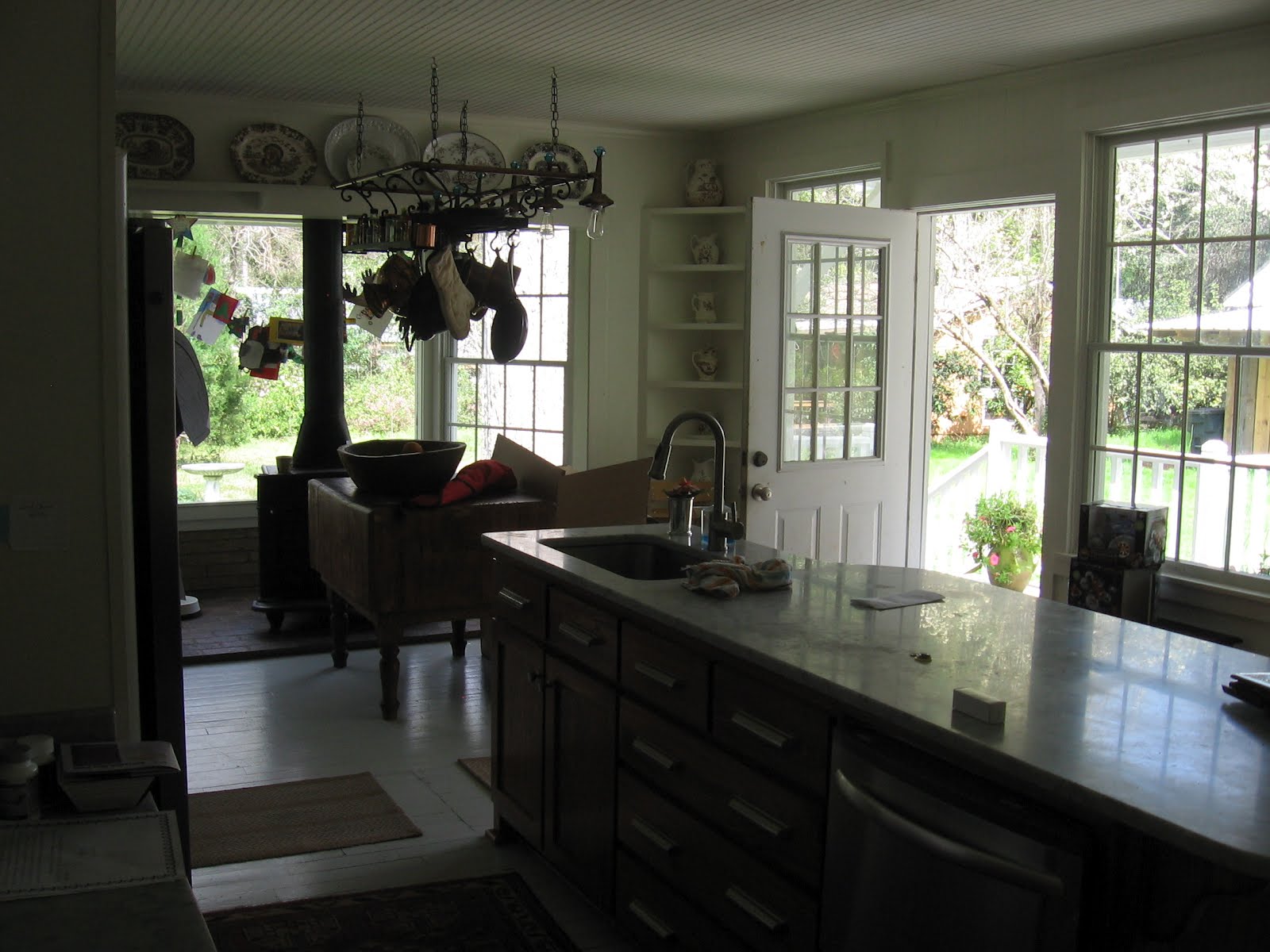 You still enter the house from the kitchen, always awkward, but for the visitor very warm and charming.
The wide center hall is enhanced by the new owners' antiques--and by their good taste in keeping things simple.

They've added a building at the back where they can entertain and just chill out. This is where there was once a chicken house, or a stable, depending on which child tells the story. We had both, at different points in time. Later my father had a carport built, which soon was used for storage and basically became, as Mama would say, a junk pile. It is now cleaned up for useful living space.
I came away from my visit feeling happy and a little nostalgic. But I had long since given the house away in my mind. The property still holds memories, and the new family will build a new life revolving around the heritage of home that shines throughout the simple space. These pictures I shot today give a feeling of what a wonderful house it is for all time.
Monday, February 06, 2012
I Went Somewhere Else
 It was overcast and cool, but I had been inside my little cottage most of the day. I knew there was a big football game that would engage the whole country, and if you read yesterday's post you know how I feel about that, so I was looking for something else to do.
 Tinker Tailor Soldier Spy had ended its run at the local cineplex, replaced by Hugo, a fantasy about the early days of motion pictures. In 3-D, no less. It had earned critical praise and not a few awards and nominations for more. There was a showing at 4:40 which would take me away from my TV set for most of the period absorbed by pre-game and post-game conjecture about who was going to do what to whom and what the other side would have to do then.
No question, I was going to see Hugo. There was little traffic on the highways--all those Super Bowl parties, no doubt--and the movie house was all but empty. I took my sunglasses as they were handed to me at the box office and put them on when instructed.
I was enchanted by Hugo. For the first hour, which did move a bit slowly, I worked on suspending disbelief. It was basically a children's movie and I wished I had my grandsons with me and wished they were about six and nine again. I had to settle for my own inner child, who is about five in today's years. She loved it.
My outer adult questioned whether this flick really demanded 3-D, but had to admit it enhanced the show. I literally felt transported to the inside of a clock in a Paris train terminal of long ago, and I marveled at the clarity of the blue eyes of a boy named Asa Butterfield, and soon I was seeing the world through his eyes. In a charming cameo, Jude Law played his father. Ben Kingsley played a villainous old man. A little too cute for words was Chloe Grace Moretz as the well-read smarty pants who accompanies Hugo in his adventures.
I love movies about movies, at least the way they're doing them these days. (On the other hand, I have to say I enjoyed Singin' in the Rain more than The Artist) but I liked Hugo as much as any older film.
Hugo watches the passing scene through the clock in the terminal, where he lives, as one would watch a movie. He tells that he and his father used to go to movies and that his father told him about a movie he'd seen as a child in which a rocket hit the man in the moon right in the eye "And it was as if he was seeing his own dreams." I've seen that ancient bit of movie footage myself and loved the idea of a child in Paris seeing it for the first time. Hugo takes his new friend to her first movie, which shows Harold Lloyd hanging over the city, suspending himself from the hands of a giant clock. This is not the last time we see a scene of someone hanging from a clock in Hugo. I recently saw Tom Cruise hanging off the side of the building in an adventure flick but missed the Harold Lloyd reference. Hugo brings it home.
The experience of Hugo reminded me of a book I read five years ago and wrote a blog post about. My post was called "Dreaming the Movies" and you can find it if you type those words in the search box above. I won't go into all of it here, but the book described the experience of movies compared to the experience of dreams. Hugo captures the experience of both, telling the audience that that is the way it's supposed to work. In Hugo, it worked like a charm for me.
So I escaped the football game, came home to a disappointing episode of Downton Abbey, and climbed into my dreams for a full and pleasant night.
Sunday, February 05, 2012
No to the Super Bowl
It was in the 1950s--probably midway--when I attended my last football game. Fairhope's biggest rival was Foley. It was the biggest game in the season.
In those days I went to Fairhope's "other" school, the little School of Organic Education with an enrollment of about 50 in the high school. My friends and I faithfully went to all the home games of Fairhope High. I sat with five or six lifelong friends (they are til this day) and thrilled to the sound of the bands, the atmosphere charged by the energy of cheerleaders--the smell of autumn in the air and all the trappings of the game. Going to a football game was exciting, and Fairhope always had a good, competitive team. The Foley game was the highlight of the year.
This particular year Fairhope was winning by a big lead. It was several years before Kenny Stabler was on the Foley team. We wouldn't have known his name in those days anyway.
All I know for sure is that Foley was not going to win this one. It was a slaughter, and we knew it was a slaughter before the end of the first half. That was when one of my favorite people on the planet made an astounding suggestion.
"Let's go sit on the Foley side for the second half," he said. "We can boo until they give up!"
I was shocked to hear this. Stunned and heartbroken. "No!"
But I was much more heartbroken at the response. This bright and beautiful young man got the support of all my friends and a few others from the Fairhope side. Double whammy heartbreak for the starry-eyed girl from Montrose (me).
I said, "If you do this, I'm leaving. And I'll never come to another football game." They were incredulous, but nobody supported my action.
At the break, while the bands were playing and the half-time show was going on, a group of about ten youngsters from Fairhope actually traipsed over the Foley side and found front row seats (Foley didn't have many in the stands). When the game started again there they sat, cheering wildly every time Fairhope had a successful play on the field, no matter how small, and jeering at the top of their lungs when someone on the Foley team attempted a counter action. It was a spectacle I have never forgotten.
By then I was ready to walk away from the game. I lived far enough away that I had to await a ride from my mother, who would pick me up by the time the game ended. There was no telephone nearby so I could let her know I was ready to go home early. I stood near the field but out of sight of the game, and heard the roars from the stands when Fairhope made touchdowns and the slight sounds when Foley did something that might make a point.
I knew at that moment I had changed my life with that action. Never again would I see football or any other sport as an innocent, positive aspect of American life. I would see the whole spectrum of competitive athletics as fostering the opposite of "good sportsmanship." I didn't want to learn the finer points of the game. I would never again thrill to joining the cheerleaders in their chants, yelling myself hoarse with the best of them. I would go to the basketball games for my school; I once even attended a local bush league baseball game and was bored to tears after a few innings. I tolerated sports on television when I had to. But for the next fifty years I would like football least of all.
It was a small incident, really. Over the years I've wondered why I allowed it to be so meaningful in my life. With the orgy of emotion in this country over every game--high school, college, and professional--and the obscene amount of money that controls all organized sports, I suspect this may be one of the times I was wrong. Sometimes it seems to me that football is the engine that drives my country, prepares its young men for actual battle and definitely for the hard core workplace. It makes people happy to win and win big. Cheering for the winners is a national pastime. All of this, with my teenaged decision, was lost to me for a lifetime.
Maybe it was destined to happen anyway. There are plenty of people who have things they'd rather do than watch football. Probably I would have become one of them without the scene I witnessed. Clearly I overreacted. Now when I think of the joy of high school football I remember that night and it is like a black hole in my soul. At 71 it's probably time I cleared that hole out and put something in its place. Even now I don't know what, how or even why I would have to do that, and it is a little late.
I'll never be a football fan, but over time I've learned that it's not the game that creates the dark side in otherwise good people. The episode signaled the beginning of my loss of innocence, but it was highly personal and might have ended another way if I had not been so judgmental of those near and dear friends. I shall find other things to do than attend a Super Bowl party this evening. Maybe I'll use the time to work on ways to replace that memory and not hold all of the culture of football responsible for the bad behavior of a few teenagers in a remote utopian enclave of the distant past.
In those days I went to Fairhope's "other" school, the little School of Organic Education with an enrollment of about 50 in the high school. My friends and I faithfully went to all the home games of Fairhope High. I sat with five or six lifelong friends (they are til this day) and thrilled to the sound of the bands, the atmosphere charged by the energy of cheerleaders--the smell of autumn in the air and all the trappings of the game. Going to a football game was exciting, and Fairhope always had a good, competitive team. The Foley game was the highlight of the year.
This particular year Fairhope was winning by a big lead. It was several years before Kenny Stabler was on the Foley team. We wouldn't have known his name in those days anyway.
All I know for sure is that Foley was not going to win this one. It was a slaughter, and we knew it was a slaughter before the end of the first half. That was when one of my favorite people on the planet made an astounding suggestion.
"Let's go sit on the Foley side for the second half," he said. "We can boo until they give up!"
I was shocked to hear this. Stunned and heartbroken. "No!"
But I was much more heartbroken at the response. This bright and beautiful young man got the support of all my friends and a few others from the Fairhope side. Double whammy heartbreak for the starry-eyed girl from Montrose (me).
I said, "If you do this, I'm leaving. And I'll never come to another football game." They were incredulous, but nobody supported my action.
At the break, while the bands were playing and the half-time show was going on, a group of about ten youngsters from Fairhope actually traipsed over the Foley side and found front row seats (Foley didn't have many in the stands). When the game started again there they sat, cheering wildly every time Fairhope had a successful play on the field, no matter how small, and jeering at the top of their lungs when someone on the Foley team attempted a counter action. It was a spectacle I have never forgotten.
By then I was ready to walk away from the game. I lived far enough away that I had to await a ride from my mother, who would pick me up by the time the game ended. There was no telephone nearby so I could let her know I was ready to go home early. I stood near the field but out of sight of the game, and heard the roars from the stands when Fairhope made touchdowns and the slight sounds when Foley did something that might make a point.
I knew at that moment I had changed my life with that action. Never again would I see football or any other sport as an innocent, positive aspect of American life. I would see the whole spectrum of competitive athletics as fostering the opposite of "good sportsmanship." I didn't want to learn the finer points of the game. I would never again thrill to joining the cheerleaders in their chants, yelling myself hoarse with the best of them. I would go to the basketball games for my school; I once even attended a local bush league baseball game and was bored to tears after a few innings. I tolerated sports on television when I had to. But for the next fifty years I would like football least of all.
It was a small incident, really. Over the years I've wondered why I allowed it to be so meaningful in my life. With the orgy of emotion in this country over every game--high school, college, and professional--and the obscene amount of money that controls all organized sports, I suspect this may be one of the times I was wrong. Sometimes it seems to me that football is the engine that drives my country, prepares its young men for actual battle and definitely for the hard core workplace. It makes people happy to win and win big. Cheering for the winners is a national pastime. All of this, with my teenaged decision, was lost to me for a lifetime.
Maybe it was destined to happen anyway. There are plenty of people who have things they'd rather do than watch football. Probably I would have become one of them without the scene I witnessed. Clearly I overreacted. Now when I think of the joy of high school football I remember that night and it is like a black hole in my soul. At 71 it's probably time I cleared that hole out and put something in its place. Even now I don't know what, how or even why I would have to do that, and it is a little late.
I'll never be a football fan, but over time I've learned that it's not the game that creates the dark side in otherwise good people. The episode signaled the beginning of my loss of innocence, but it was highly personal and might have ended another way if I had not been so judgmental of those near and dear friends. I shall find other things to do than attend a Super Bowl party this evening. Maybe I'll use the time to work on ways to replace that memory and not hold all of the culture of football responsible for the bad behavior of a few teenagers in a remote utopian enclave of the distant past.
Friday, February 03, 2012
My Portable Life
Here I am in Fairhope again, driving around in a rental car and staying in a sweet one room cottage. It's one room with a little kitchen, a little bathroom--and a lot of charm. It's in a pretty corner of Fairhope, close to town (and to the bay, of course--every property in Fairhope is always advertised as "Walk to town and bay"). I do walk some, and drive some too. I deliberately go out of my way so that I might see what has changed and what has stayed the same. I show up at the door of people I used to know and they are telling me the latest news and gossip.
 Above is very close to the center of town, the gaping hole on Fairhope Avenue where the movie house used to be. Soon a new edifice will be erected here for yet another building for gift shops and tourist attractions. It's the way things are going (and have gone for the past 25 years or so).
The weather is pleasant--it'll be 73 degrees today--and birds are singing and people are smiling. All of that is to be expected in Fairhope at this time of year, although I'm told it's been a mild winter, even for here.
I lived here for almost 20 years before I decided to move away in December of 2007--to a more hostile climate and a more confrontational atmosphere. I live in New Jersey, and for the first year, whenever I met someone and said I had just moved there from Alabama, people said, "Oh, you're the one..." I'm close to New York City, where I can go to matinees of first rate productions of first rate plays as often as I can afford it, and where I'm a 20 minute bus ride from a trip to visit my daughter and grandsons.
Whatever I may say about not missing Fairhope, it's always fun to return. We who leave are tempted to quote Thomas Wolfe's famous title You Can't Go Home Again, but I have found it possible and in many ways the best of both worlds.
Most of the time so far on this trip I find I'm still doing what I do in my non-vacation life. I check and write email, go on Facebook and make snarky comments to strangers. Soon I'll resume sending my query letter to agents who may be willing and able to hawk my novel to legitimate publishers. I've gotten two rejections so far after sending the query to ten high-powered agents--I should have a full complement by the time I go home at the end of March.
I'm catching up with friends and relations one by one and observing the changes in all. I think it's going to be a lovely two months--even though I can't say I left to get away from bad weather. I came home for a visit.
 It's one room with a little kitchen, a little bathroom--and a lot of charm. It's in a pretty corner of Fairhope, close to town (and to the bay, of course--every property in Fairhope is always advertised as "Walk to town and bay"). I do walk some, and drive some too. I deliberately go out of my way so that I might see what has changed and what has stayed the same. I show up at the door of people I used to know and they are telling me the latest news and gossip.
 Above is very close to the center of town, the gaping hole on Fairhope Avenue where the movie house used to be. Soon a new edifice will be erected here for yet another building for gift shops and tourist attractions. It's the way things are going (and have gone for the past 25 years or so).
The weather is pleasant--it'll be 73 degrees today--and birds are singing and people are smiling. All of that is to be expected in Fairhope at this time of year, although I'm told it's been a mild winter, even for here.
I lived here for almost 20 years before I decided to move away in December of 2007--to a more hostile climate and a more confrontational atmosphere. I live in New Jersey, and for the first year, whenever I met someone and said I had just moved there from Alabama, people said, "Oh, you're the one..." I'm close to New York City, where I can go to matinees of first rate productions of first rate plays as often as I can afford it, and where I'm a 20 minute bus ride from a trip to visit my daughter and grandsons.
Whatever I may say about not missing Fairhope, it's always fun to return. We who leave are tempted to quote Thomas Wolfe's famous title You Can't Go Home Again, but I have found it possible and in many ways the best of both worlds.
Most of the time so far on this trip I find I'm still doing what I do in my non-vacation life. I check and write email, go on Facebook and make snarky comments to strangers. Soon I'll resume sending my query letter to agents who may be willing and able to hawk my novel to legitimate publishers. I've gotten two rejections so far after sending the query to ten high-powered agents--I should have a full complement by the time I go home at the end of March.
I'm catching up with friends and relations one by one and observing the changes in all. I think it's going to be a lovely two months--even though I can't say I left to get away from bad weather. I came home for a visit.
Saturday, July 30, 2011
My Grandma Moses Book
I moved back to Fairhope in 1988, expecting to live out my days there. My mother was nearing 80 and my husband, 17 years my senior, was having a hard time in retirement and was suffering from a terrible disease: Alcoholism. I thought Fairhope would be a good place for all of us.
The twenty years I lived there proved full of changes for us. I found myself through the 12-Step programs (mostly Al-Anon; but six months in AA was a huge help as well), but my husband didn't. He died at the age of 78. My mother lived many more years and made it to 92. In the meantime, I discovered Fairhope's history through working at the Marietta Johnson Museum, and dedicated myself to the recovery of the School of Organic Education as well. I did the best I could, but the school suffered one of its most traumatic periods during this time. All the while I was watching Fairhope change and savoring my memories of what it once was, and learned its deeper nature. I started this blog and continued writing as constantly as I had all my life; poems, journals, letters--and collaborated with Robert E. Bell on a book about Fairhope memories called Meet Me at the Butterfly Tree.
I began to think it would be nice to live out my old age like Grandma Moses, but instead of painting charming primitives I would write novels set in Fairhope in its early days, little word pictures of the kind of people who once moved to the utopian village with an eye to changing the world for the better. Marietta Johnson would be a peripheral character in these books, as would E.B. Gaston, the single tax advocate who founded the town with a goal of demonstrating economic reform, but the books would be about other people and their adventures in the village in bygone days. Fairhope didn't last for me after both my husband and my mother died there, but it haunts me in my new home and I still have a need to write about it.
I wrote The Fair Hope of Heaven, another non-fiction book about Fairhope and some of its eccentrics and nonconformists, which I had to self-publish and has just about made its nut back. It's still around, at the local Fairhope bookstore Page & Palette and on amazon dot com. I tried to place it in independent bookstores in faraway places like Montgomery but was told that nobody in Montgomery had any interest in Fairhope. I've given and sold copies to friends all over the world who never heard of Fairhope and they love the book, but they are friends so they're probably just being nice. I thought it was kind of a Lake Woebegone Days with a single-tax slant, but publishers think otherwise.
Now I'm giving fiction a try. My first Grandma Moses book has the working title of That Was Tomorrow, but is my second choice of a working title and it too may be changed. I'm in the first rewrite stage, and damned if it doesn't read sorta like a Grandma Moses painting--quaint and maybe a bit awkward, but with heart and an old-fashioned style, and a certain sense of the place. I tried to marginalize Mrs. Johnson, but she has become a major character in spite of my best efforts. I may cut a great deal before an agent or an editor sees it, but I do not plan to self publish under any circumstances. (Famous last words)
Grandma Moses painted her first picture at the age of 78, because it was easier than baking a Christmas gift for the postman. When her work was discovered years later in the window of the local drugstore (at $3 and $5, depending on the size of the work), she was lucky that the art dealer who snapped them all up didn't say, "Very good work, but it would never be of interest to anybody outside of Hoosik Falls!"
Maybe I'll be lucky this time. My website tells all.
The twenty years I lived there proved full of changes for us. I found myself through the 12-Step programs (mostly Al-Anon; but six months in AA was a huge help as well), but my husband didn't. He died at the age of 78. My mother lived many more years and made it to 92. In the meantime, I discovered Fairhope's history through working at the Marietta Johnson Museum, and dedicated myself to the recovery of the School of Organic Education as well. I did the best I could, but the school suffered one of its most traumatic periods during this time. All the while I was watching Fairhope change and savoring my memories of what it once was, and learned its deeper nature. I started this blog and continued writing as constantly as I had all my life; poems, journals, letters--and collaborated with Robert E. Bell on a book about Fairhope memories called Meet Me at the Butterfly Tree.
I began to think it would be nice to live out my old age like Grandma Moses, but instead of painting charming primitives I would write novels set in Fairhope in its early days, little word pictures of the kind of people who once moved to the utopian village with an eye to changing the world for the better. Marietta Johnson would be a peripheral character in these books, as would E.B. Gaston, the single tax advocate who founded the town with a goal of demonstrating economic reform, but the books would be about other people and their adventures in the village in bygone days. Fairhope didn't last for me after both my husband and my mother died there, but it haunts me in my new home and I still have a need to write about it.
I wrote The Fair Hope of Heaven, another non-fiction book about Fairhope and some of its eccentrics and nonconformists, which I had to self-publish and has just about made its nut back. It's still around, at the local Fairhope bookstore Page & Palette and on amazon dot com. I tried to place it in independent bookstores in faraway places like Montgomery but was told that nobody in Montgomery had any interest in Fairhope. I've given and sold copies to friends all over the world who never heard of Fairhope and they love the book, but they are friends so they're probably just being nice. I thought it was kind of a Lake Woebegone Days with a single-tax slant, but publishers think otherwise.
Now I'm giving fiction a try. My first Grandma Moses book has the working title of That Was Tomorrow, but is my second choice of a working title and it too may be changed. I'm in the first rewrite stage, and damned if it doesn't read sorta like a Grandma Moses painting--quaint and maybe a bit awkward, but with heart and an old-fashioned style, and a certain sense of the place. I tried to marginalize Mrs. Johnson, but she has become a major character in spite of my best efforts. I may cut a great deal before an agent or an editor sees it, but I do not plan to self publish under any circumstances. (Famous last words)
Grandma Moses painted her first picture at the age of 78, because it was easier than baking a Christmas gift for the postman. When her work was discovered years later in the window of the local drugstore (at $3 and $5, depending on the size of the work), she was lucky that the art dealer who snapped them all up didn't say, "Very good work, but it would never be of interest to anybody outside of Hoosik Falls!"
Maybe I'll be lucky this time. My website tells all.
Tuesday, June 21, 2011
Living in a Magical Place

Photo by Susan Stein
I just saw a movie about life as it once was, as it was conceived by its Creator to be, and as it is. This is the profound The Tree of Life, which got me thinking about my own book.
The Tree of Life was set in a little Texas town in the 1950's; my book, That Was Tomorrow, was set in Fairhope in 1922. There is not really any similarity between the two works, but as an author perhaps I can be forgiven the indulgence of imagining my little novel being made into a little Indie movie one of these days. In my mind I've cast a few of the leading players, and I did that as I wrote. The hardest part of my movie project would be to recreate the Fairhope of 1922. I suspect it would have to be built from scratch on a Hollywood back lot.
The Fairhope of today really doesn't look anything like the one of 1922. In those days the population was under 500, and the houses were literally few and far between. The streets were not paved, there were few automobiles, and there were few shops. There were several guest homes, hotels, and hostelries, as Fairhope was a retreat for intellectual Northerners in the winter. There was a pier stretching out into Mobile Bay, where steamers docked after ferrying people from the city. There was a main street, Fairhope Avenue, and it was crossed by Section Street. At that corner were some of the businesses in town--a pharmacy, a harness shop, a general store, and next door a millinery and gift shop. As you walked down the hill--no sidewalks, just packed dirt--there was the office of the local weekly newspaper, The Courier, the doctor's office, and then, on Church Street was The Gables, a large wooden hotel run by Capt. and Mrs. Jack Cross. A few more guest houses, a cable car running down and up the hill to the bay, and the Colonial Inn on the corner of the street running parallel to the bay and Cliff Drive. Cliffs and gullies. Satsuma trees everywhere. Little kids climbing trees and playing in the gullies.
The Tree of Life was filmed in Smithville, TX. So was Hope Floats, and apparently many other movies with a nostalgic setting. For a moment during the film, when I saw a shred of Spanish moss on the trees, I thought it might make a nice backdrop for That Was Tomorrow. But really not. When they walked through town it was a typical, town-square-in-the-middle, layout from days past. In Fairhope there was Knoll Park, azaleas, wisteria, and all the beautiful beach parks. My characters have a number of cookouts on the beach.
Sonny Brewer, author of The Poet of Tolstoi Park, a novel set in roughly the same place and time as my book, said they considered Bayou La Batre, AL when it was under consideration for a movie. How they'd get the sun to go down in the East I don't know, but in Hollywood, all things are possible.
As a matter of fact, I'm still in dreamland myself. The book has been sent to three friends for evaluation of the first draft. If the reaction is good I still have a lot of work to do, depending on their suggestions. If the reaction is universally not good, the book project will be set aside indefinitely. Probably I'll become a more active blogger again.
In the meantime, if you can think of any location that's a little like Fairhope would have been in 1922, let me know.
Tuesday, May 17, 2011
Spring in Fairhope, 1922
This is an excerpt from the novel That Was Tomorrow, which takes place in Fairhope in 1921-22. It centers around the bohemian community of Fairhope of those days, particularly the teachers at the School of Organic Education. The protagonists all moved to the town as disciples of Marietta Johnson, who was a world-famous proponent of the progressive education movement, and had founded her school as a demonstration of that educational theory. "The Sieve" is the nickname the two young women, Amelia and Avery, have for the cottage they are renting, which has a very leaky roof.
It was still March, but Fairhope was already in the full bloom of spring. Days were sunny, the sky was light blue with little puffs of clouds here and there, and flowers opened their faces on footpaths, roadsides, and in the trees. The first blossoms had appeared as splashes of mauve on redbud trees, but the neighboring dogwoods, with their layered branches now shelves for their white four-leaf blooms, completed the look of lacy color dotting the town.
Years before, the locals had gathered in a civic group to plant azalea bushes around the perimeter of Knoll park. At at this time of year the big, raggedly uneven bushes came into bloom all at once, as if blanketed in pink. Color was accented by large azaleas in white, and there were shades of pink that bloomed in sequence, finishing with the stylish deep, almost red shade known as “Pride of Mobile.”
A wisteria vine, planted on a magnolia tree adjacent to the school’s library, broke into a profusion of lavendar blossoms which exuded a heady sweet fragrance into the breeze. The vine actually connected two trees, and would one day grow big enough to climb on; already it provided a seat between the trees, and the flowers opened with a sweet, springtime smell that would be unforgettable to generations of school children.
Although the temperature usually hovered in the low 80s, humidity was not so high as usual, and it felt at if one could inhale spring itself. The air had a lightness to it that seemed to transfer to the mood of people.
More and more often, Jim Holloway was a visitor to The Sieve. As his romantic relationship with Avery grew more intense, Amelia was more comfortable avoiding the intimate vision of them together, leaving the place to them to go to watch the sunset on the pier, then take a walk around town, sometimes with a book, sometimes taking a notebook to write down ideas for class projects. Some evenings she spent at The Gables, talking with Capt. Cross, who could answer many questions, particularly about history. He recommended books to her, and lent her his copy of Tolstoy’s short stories.
This night, when Amelia came into the parlor at The Gables, Idella Cross presented with an envelope, with her name on it, in Maxwell Taylor’s unmistakable handwriting.
“Mr. Taylor asked me to give this to you,” she said.
“Max? How strange!” Amelia said.
“Oh, I wouldn’t think strange,” Mrs. Cross said simply, and walked away, into the kitchen.
“My Dear Amelia,” read the letter. “I must talk to you. Please meet me at the northeast corner of Knoll Park, Magnolia and Bayview, at 8 P.M. Maxwell Taylor.”
Amelia was somewhat anxious reading this. There could be some bad news that Max wanted to reveal, or some personal situation. Perhaps he was going to be called away for a family emergency, or perhaps he was in some sort of trouble at the school. It was half an hour before the appointed time and there was nothing for Amelia to do but bide her time at The Gables until then.
Capt. Cross was working on a Mozart sonata on the piano, and she had a Rousseau book to read about the nature and needs of the child. She chose her favorite chair in The Gables’ main room, a threadbare old carpet rocker which had the smell of years of musty dust to it. All the same, the book was hardly relaxing, and Capt. Cross’ struggle with Mozart did little to ease her tension.
It was hardly a five-minute walk to the spot designated by Max’s missive. He would be coming from the cottage at Bancroft and Pine Street where he rented a room. She decided to walk down Fairhope Avenue to the Knoll Park corner. It was dark now, a night not unlike when she and Max walked this way to Marie Howland’s, when she got her first look at the little town illuminated by Southern moonlight.
Max was standing near a dogwood tree at the edge of the park. When she got close enough, he said, “Good to see you.”
“Hello, Max.”
What was he going to tell her? Tree frogs were deafening for a moment.
“I see you got my letter,” he said, with a smile curling one corner of his mouth.
There are people, she thought, whose faces are simply not designed for smiling. He fixed her with his eyes, although they seemed to be trembling in a strange and inexplicable way. All she knew to do was look back at him firmly, hoping a steady gaze would relieve the anxiety he seemed to be feeling.
“Yes, although the postal service might be disappointed at the loss of revenue.”
I never thought of that.”
Again there was silence but for the frogs.
“I thought this would be a nice place to meet.”
“And so it is. The night reminds me of our first meeting, walking Marie Howland home.”
He nodded, and clearly began to think about that night.
“This is different,” he said after a pause. “That was before I loved you.”
“Oh, Max!”
“Now let me speak.”
She took a breath and nodded.
“I’ve given this a lot of thought. It was not something I was seeking. ‘It’ found me instead. I’m kind of a solitary fellow, pretty much independent and I’ve always been happy with that—depends upon what you mean by happy, I guess. I was content with it; I didn’t expect more—this damned town—”
“Maybe it’s all these flowers,” she said.
“Flowers and springtime, is that what you think?”
“I don’t know what to think.”
“Well, let me tell you something then. It’s not flowers and springtime! It’s—it’s a wistful scarecrow at Halloween, a pair of eyes glowing in the reflection of firelight, the music of a laugh at a folk tale. It’s delicate hands comforting a weeping child, and feet skipping with children to a tune for a pageant.”
He was warming up now.
It’s camellias and roses for Christmas on a warm day. It’s sunsets on the pier. It’s ‘A Long Long Trail A-Winding.’ It’s the accidental grasp of a hand doing an English country dance. It’s the scent of pine and wisteria in the breeze. It’s this damn, irresistible crazy quilt of a town—but most of all it’s you, my beautiful Amelia. Oh, dear God, let me say that at last. My beautiful Amelia. Okay.” He took a breath, then he launched into an imitation of Ethel Barrymore. “That’s all there is.”
“There isn’t any more?” Amelia picked up on the imitation, which was current in the day, lines in a play the actress had spoken years before. Maxwell at his best was all about the theatre.
“No?” he said, making it a question, imploring her to take it as more than he had said.
“That’s a great deal, Maxwell.”
“Yes. It’s profound. Not so deep as a well, maybe, nor so broad as a church
door—”
“Now you’re quoting.”
“Well, at least I quote from the best.”
“I liked when you were being original.”
“You did?” Now he looked at her, hopeful for the first moment.
“It’s like being in a play.”
“There are times when life is,” Max said. Now he was staring at her, trying to fathom her soul.
“This is new to me,” she said. She was not sure how to capture in words the confusion of feeling that swept over her. But she knew she had to say something.
“Dear Max.”
He stepped over to her and put his arms around her. Amelia did not resist. She knew he was going to kiss her and she would not resist.
The world of sunsets and wisteria blossoms and firelight and folk tales came crashing about her as she responded to his gentle, long kiss. There was a crescendo of tree frogs when he stepped back at last and looked into her face, still with his arms around her. She was unsteady on her feet. Caught in the moment, she could not speak. Her mind was flooded with conflicting thoughts and she felt stirrings and tingling throughout her body that she had never felt before.
All at once Max was laughing.
“You dropped your books,” he said. He picked them up from the patch of grass.“Ah, Tolstoy!” he said, looking at the top book. “How appropriate!”
“Can you blame me?” she said. “About dropping them I mean, not about the books. I feel—a little foolish.”
“Ah no, not foolish, I hope. I did my best—”
“I didn’t mean that. You did very well.”
“Yes, I know,” he said.
“I think you are more accustomed to being in plays than I,” she said.
“You know this isn’t a play.”
“What is it then?”
“It’s real life.”
“Please, Max,” Amelia said. “This is going to take me some time.”
“Oh, ‘please,’ yourself,” he said. “Do not think so much. Do not make this a problem.
I kissed you in the park, I said some things. You liked it.”
“Yes.”
“I shall walk you home now,” he said. “And then I’ll dance all the way to my own humble abode. Then tomorrow…”
“Tomorrow?”
“That’s the one one-word question to which there is no answer,” said Max.
The two walked up Bayview, through the big old oak trees, both of them moved by the moon as it shone through the Spanish moss. He held her hand.
“Avery and Jim are at The Sieve,” she told him.
“That’s good, I think. They are at The Sieve, and you and I are walking down the street. Life goes on.”
She wasn’t sure if Maxwell understood the significance of Jim being with Avery.
“They are a couple.”
“Well, yes, I had hopes. Jim has had his eye on her for months, even before the
departure of the volatile Sarah.”
“I hadn’t seen that,” Amelia said.
He said nothing.
“I shall drop you at the door,” Max said. “I don’t know that I’m able to take any more excitement tonight.”
She turned to him as they reached the door and he leaned down and kissed her cheek.
“Promise me,” he said, “that you won’t think too much.”
“Not an easy promise to keep,” she said.
“Sure it is. If your mind races, just insert thoughts about Tolstoy and Rousseau.”
“And Marietta Johnson?”
“Well, Marietta Johnson too—but I think the distant gods are more comforting than those close to home.”
As she climbed the stairs, Amelia heard his voice in her head, repeating, “Tomorrow is the one-word question to which there is no answer,” and she felt the memory of the kiss suffuse her body with tingling hope.
When she got into her bed a few minutes later, she had not noticed whether or not Jim was still in the house. She wrapped her arms around her spare pillow and wished for her old teddy bear.
That Was Tomorrow is available at amazon.com., Barnes & Noble.com, iBooks, and from my website.
It was still March, but Fairhope was already in the full bloom of spring. Days were sunny, the sky was light blue with little puffs of clouds here and there, and flowers opened their faces on footpaths, roadsides, and in the trees. The first blossoms had appeared as splashes of mauve on redbud trees, but the neighboring dogwoods, with their layered branches now shelves for their white four-leaf blooms, completed the look of lacy color dotting the town.
Years before, the locals had gathered in a civic group to plant azalea bushes around the perimeter of Knoll park. At at this time of year the big, raggedly uneven bushes came into bloom all at once, as if blanketed in pink. Color was accented by large azaleas in white, and there were shades of pink that bloomed in sequence, finishing with the stylish deep, almost red shade known as “Pride of Mobile.”
A wisteria vine, planted on a magnolia tree adjacent to the school’s library, broke into a profusion of lavendar blossoms which exuded a heady sweet fragrance into the breeze.
 The vine actually connected two trees, and would one day grow big enough to climb on; already it provided a seat between the trees, and the flowers opened with a sweet, springtime smell that would be unforgettable to generations of school children.
Although the temperature usually hovered in the low 80s, humidity was not so high as usual, and it felt at if one could inhale spring itself. The air had a lightness to it that seemed to transfer to the mood of people.
More and more often, Jim Holloway was a visitor to The Sieve. As his romantic relationship with Avery grew more intense, Amelia was more comfortable avoiding the intimate vision of them together, leaving the place to them to go to watch the sunset on the pier, then take a walk around town, sometimes with a book, sometimes taking a notebook to write down ideas for class projects. Some evenings she spent at The Gables, talking with Capt. Cross, who could answer many questions, particularly about history. He recommended books to her, and lent her his copy of Tolstoy’s short stories.
This night, when Amelia came into the parlor at The Gables, Idella Cross presented with an envelope, with her name on it, in Maxwell Taylor’s unmistakable handwriting.
“Mr. Taylor asked me to give this to you,” she said.
“Max? How strange!” Amelia said.
“Oh, I wouldn’t think strange,” Mrs. Cross said simply, and walked away, into the kitchen.
“My Dear Amelia,” read the letter. “I must talk to you. Please meet me at the northeast corner of Knoll Park, Magnolia and Bayview, at 8 P.M. Maxwell Taylor.”
Amelia was somewhat anxious reading this. There could be some bad news that Max wanted to reveal, or some personal situation. Perhaps he was going to be called away for a family emergency, or perhaps he was in some sort of trouble at the school. It was half an hour before the appointed time and there was nothing for Amelia to do but bide her time at The Gables until then.
Capt. Cross was working on a Mozart sonata on the piano, and she had a Rousseau book to read about the nature and needs of the child. She chose her favorite chair in The Gables’ main room, a threadbare old carpet rocker which had the smell of years of musty dust to it. All the same, the book was hardly relaxing, and Capt. Cross’ struggle with Mozart did little to ease her tension.
It was hardly a five-minute walk to the spot designated by Max’s missive. He would be coming from the cottage at Bancroft and Pine Street where he rented a room. She decided to walk down Fairhope Avenue to the Knoll Park corner. It was dark now, a night not unlike when she and Max walked this way to Marie Howland’s, when she got her first look at the little town illuminated by Southern moonlight.
Max was standing near a dogwood tree at the edge of the park. When she got close enough, he said, “Good to see you.”
“Hello, Max.”
What was he going to tell her? Tree frogs were deafening for a moment.
“I see you got my letter,” he said, with a smile curling one corner of his mouth.
There are people, she thought, whose faces are simply not designed for smiling. He fixed her with his eyes, although they seemed to be trembling in a strange and inexplicable way. All she knew to do was look back at him firmly, hoping a steady gaze would relieve the anxiety he seemed to be feeling.
“Yes, although the postal service might be disappointed at the loss of revenue.”
I never thought of that.”
Again there was silence but for the frogs.
“I thought this would be a nice place to meet.”
“And so it is. The night reminds me of our first meeting, walking Marie Howland home.”
He nodded, and clearly began to think about that night.
“This is different,” he said after a pause. “That was before I loved you.”
“Oh, Max!”
“Now let me speak.”
She took a breath and nodded.
“I’ve given this a lot of thought. It was not something I was seeking. ‘It’ found me instead. I’m kind of a solitary fellow, pretty much independent and I’ve always been happy with that—depends upon what you mean by happy, I guess. I was content with it; I didn’t expect more—this damned town—”
“Maybe it’s all these flowers,” she said.
“Flowers and springtime, is that what you think?”
“I don’t know what to think.”
“Well, let me tell you something then. It’s not flowers and springtime! It’s—it’s a wistful scarecrow at Halloween, a pair of eyes glowing in the reflection of firelight, the music of a laugh at a folk tale. It’s delicate hands comforting a weeping child, and feet skipping with children to a tune for a pageant.”
He was warming up now.
It’s camellias and roses for Christmas on a warm day. It’s sunsets on the pier. It’s ‘A Long Long Trail A-Winding.’ It’s the accidental grasp of a hand doing an English country dance. It’s the scent of pine and wisteria in the breeze. It’s this damn, irresistible crazy quilt of a town—but most of all it’s you, my beautiful Amelia. Oh, dear God, let me say that at last. My beautiful Amelia. Okay.” He took a breath, then he launched into an imitation of Ethel Barrymore. “That’s all there is.”
“There isn’t any more?” Amelia picked up on the imitation, which was current in the day, lines in a play the actress had spoken years before. Maxwell at his best was all about the theatre.
“No?” he said, making it a question, imploring her to take it as more than he had said.
“That’s a great deal, Maxwell.”
“Yes. It’s profound. Not so deep as a well, maybe, nor so broad as a church
door—”
“Now you’re quoting.”
“Well, at least I quote from the best.”
“I liked when you were being original.”
“You did?” Now he looked at her, hopeful for the first moment.
“It’s like being in a play.”
“There are times when life is,” Max said. Now he was staring at her, trying to fathom her soul.
“This is new to me,” she said. She was not sure how to capture in words the confusion of feeling that swept over her. But she knew she had to say something.
“Dear Max.”
He stepped over to her and put his arms around her. Amelia did not resist. She knew he was going to kiss her and she would not resist.
The world of sunsets and wisteria blossoms and firelight and folk tales came crashing about her as she responded to his gentle, long kiss. There was a crescendo of tree frogs when he stepped back at last and looked into her face, still with his arms around her. She was unsteady on her feet. Caught in the moment, she could not speak. Her mind was flooded with conflicting thoughts and she felt stirrings and tingling throughout her body that she had never felt before.
All at once Max was laughing.
“You dropped your books,” he said. He picked them up from the patch of grass.“Ah, Tolstoy!” he said, looking at the top book. “How appropriate!”
“Can you blame me?” she said. “About dropping them I mean, not about the books. I feel—a little foolish.”
“Ah no, not foolish, I hope. I did my best—”
“I didn’t mean that. You did very well.”
“Yes, I know,” he said.
“I think you are more accustomed to being in plays than I,” she said.
“You know this isn’t a play.”
“What is it then?”
“It’s real life.”
“Please, Max,” Amelia said. “This is going to take me some time.”
“Oh, ‘please,’ yourself,” he said. “Do not think so much. Do not make this a problem.
I kissed you in the park, I said some things. You liked it.”
“Yes.”
“I shall walk you home now,” he said. “And then I’ll dance all the way to my own humble abode. Then tomorrow…”
“Tomorrow?”
“That’s the one one-word question to which there is no answer,” said Max.
The two walked up Bayview, through the big old oak trees, both of them moved by the moon as it shone through the Spanish moss. He held her hand.
“Avery and Jim are at The Sieve,” she told him.
“That’s good, I think. They are at The Sieve, and you and I are walking down the street. Life goes on.”
She wasn’t sure if Maxwell understood the significance of Jim being with Avery.
“They are a couple.”
“Well, yes, I had hopes. Jim has had his eye on her for months, even before the
departure of the volatile Sarah.”
“I hadn’t seen that,” Amelia said.
He said nothing.
“I shall drop you at the door,” Max said. “I don’t know that I’m able to take any more excitement tonight.”
She turned to him as they reached the door and he leaned down and kissed her cheek.
“Promise me,” he said, “that you won’t think too much.”
“Not an easy promise to keep,” she said.
“Sure it is. If your mind races, just insert thoughts about Tolstoy and Rousseau.”
“And Marietta Johnson?”
“Well, Marietta Johnson too—but I think the distant gods are more comforting than those close to home.”
As she climbed the stairs, Amelia heard his voice in her head, repeating, “Tomorrow is the one-word question to which there is no answer,” and she felt the memory of the kiss suffuse her body with tingling hope.
When she got into her bed a few minutes later, she had not noticed whether or not Jim was still in the house. She wrapped her arms around her spare pillow and wished for her old teddy bear.
That Was Tomorrow is available at amazon.com., Barnes & Noble.com, iBooks, and from my website.
Sunday, January 23, 2011
Looking for Mikey
 It was a beautiful, chilly Saturday morning, and I could have skipped the memorial. I knew plenty of people would be there and that I would not have been missed. But when I considered other options, my inner child kept prodding me, saying that she wanted to say goodbye to Mikey. I had to go.
 Mikey Jones was a man about town in a unique way; he owned the town and lived in every inch of it. It would seem that everybody in Fairhope knew him—and loved him deeply. That might not be easy to imagine if you never met Mikey, but if you had met him once, it was perfectly clear.
Mikey radiated joy in everything he did. It was as natural to him as breathing. To say he was friendly isn’t saying enough; he made a friend of everyone, it was his job. Once he told me that he found it funny that people assumed it was his only job, walking around town and smiling at people, doing odd jobs for them, hugging them, making them laugh. In fact, he said, he was in the oil business and traveled all the time; it was just that when he was in Fairhope he was not at work and he could do what he loved. What he loved was life itself, and people of all ages, sizes, shapes and colors. He was one of the world’s great huggers, also one of the world’s great smilers and caregivers. He cared about people more than anyone I’ve ever known.
At his memorial service, his business partner spoke, saying he had never known anyone like Mikey, and thanked God he had had the privilege of his long association with him. He made the congregation laugh when he told us that he’d never known anybody who would get to know every person who was with him on a short elevator ride. I had never been in an elevator with him, but do not doubt that for a minute. And we’re not talking about a superficial acquaintance either; he was as likely to get a name and information about a person he met in an elevator, and remember it when he saw him years later, as anywhere else.
Gina Lanaux said in her eulogy, “Mikey left a legacy of love, inspiration and passion. His many friends called him the ‘unofficial mayor of Fairhope.’ He had an insatiable appetite for good food, women of all shapes and sizes, travel, gardening, restoration of old houses and the preservation of all things Fairhope. Everything he did was about his love of life, his love of people, and he shared his positive energy with everyone.” She pointed out that every one of us in the crowded church had a wealth of Mikey stories, and I knew that, having two or three of my own, she was surely right about that. I said to my neighbor on the pew, “She nailed it,” and she, shaking her head responded, “She sure nailed it.”
He was ten years old when he moved to Fairhope from Barbados. He befriended Tommy Yeager, who shared at his memorial descriptions of life as a boy with Mikey as a friend in the most Tom Sawyer kind of way. This new boy had come from an island Tommy had never even heard of; he taught him how to explore the bay in ways he never could imagine. They swam in the bay grass and checked out the fish. They made logs into missiles they could ride through the water. Tommy was proud that he knew a few things Mikey didn’t—but Mikey caught on quick. “I had a way of finding anything we needed,” Tommy related. “He would mention wanting something and before he thought of it again, I would appear with it. What I knew was the schedule for curbside garbage pickup, which became our free yard sale.” This scavenger talent, no doubt, was a source for adventures in creativity for the two for years to come.
Girls who knew Mikey as a teenager remember that joyous charisma. When he surfed or swam he was at one with the water. He cut a dashing figure. Grace, balance and athleticism came naturally to him, and girls came naturally to him too. Once he made up his mind, however, he settled on a perfect mate, Dee Wilson of New Orleans, who married Mikey and took to his life—and loved it with him.
Tears were flowing in that beautiful church, tears of joy that we had known him and tears of recognition of how much would be missing from Fairhope now that he was gone. He had suffered a crucible for the past several years, having fought a painful personal battle with cancer, endured chemotherapy and gotten a little better for a time, and then relapsed for the inevitable end. A valiant soul and an extraordinary lover of life itself, he was as adept at facing death.
Thinking about Mikey will always be a source of strength for those of us who were blessed by his acquaintance. After the service, we were invited to join the family for refreshments. I debated with myself about whether to go and again my inner child chimed in. “Mikey would say, ‘Do anything you want,’” came the voice inside me. I went to the luncheon.
With any new problem we might have to face, we can think how Mikey would have handled it, and we will have our answers. It makes me smile to think of that.
Thursday, December 16, 2010
Fairhope's Winter Visitor
Last year I spent the month of February in Fairhope. By the time I got back to Hoboken the brutal weather was about over and I made a decision I'd come again in 2011. So as I prepare for Christmas in upstate New York with my family I'm mentally packing my bags for a jaunt to warmer climes for the month of January.
Decided to push the date forward a month, choosing January instead of February, largely because of the events surrounding the Wharton Esherick events. Mark Sfirri, woodcarver, professor, and expert in the Modernists of the Philadelphia area in the 1920's, will be talking about Esherick at the Fairhope Library at 1 P.M. January 8. As noted in previous blog posts here, I met Sfirri at an Esherick symposium at the University of Pennsylvania in October and he was very intrigued by Fairhope and the role it played in the life of Esherick, his family and friends of that period. He'll show some of Esherick's art work and sculpture and put it in the context of Fairhope in that time frame.
The next week I'll speak at a tea at the Fairhope Museum of History on the history of theatre in Fairhope, which will cover the old Shakespeare Festival, the many informal theatrical events of the 1920's and 30's, the Fairhope Little Theater of the 1940's, and the birth of Theater 98 in the late 1950s, as well as Tom Pocase's Theater 8:15 and other theatrical projects including the Equity Jubilee Fish Theater of the 1990's. I'll talk to the Baldwin Writers' Group on Jan. 15 about how I got my two books, Meet Me at The Butterfly Tree and The Fair Hope of Heaven published in the early 2000's, and I'll be signing books at Page & Palette from 2-4 that afternoon. NOTE: My novel That Was Tomorrow set in Fairhope in 1921, is available on my website or on amazon. com, Barnes & Noble. com or iBooks.
My vacation month is fast filling up. I hear that an old friend may be getting married and several who have moved away are planning to be in town for the event on the 22nd. Haven't seen some of them in two or three years, so that will be nice.
Before the visit, I thought I'd spend most of the time doing research on my novel set in Fairhope in the 1920's. It didn't work out that way, but the book is now finished and available.
Wednesday, October 13, 2010
A Time in Old Fairhope
From the novel I'm working on, That Was Tomorrow, here's an excerpt about The Gables, a hotel run by Capt. and Mrs. Jack Cross:
The first settlers, who had moved from Iowa and other parts of the Midwest, had not been farmers, but were eager to learn how to grow enough food to feed their families, and they had assumed this gloriously warm climate would provide a garden of Eden for them. By now they had learned that the soil of Fairhope was sandy and alkaline, not ideal for many crops. But they endured in a spirit of cooperation and optimism, and many had accepted conventional wisdom that citrus, particularly the new Japanese satsuma orange, might be the salvation of Fairhope’s economy. The growing season was indeed a long one, and they experimented to extend it even longer if they could by growing and preparing vegetables and fruit unknown to them before their move to the South. There was a bounty of okra, which was quite tasty when you got used to it, and there were varieties of peas, beans and nuts which they came to enjoy over time.
That initial visit, Amelia stayed at the Gables, a simple two-storey wooden building, which Mrs. Johnson had recommended to her. The Gables was a little less fashionable and less expensive than the Colonial Inn, which sat a few blocks west, on the bluff overlooking the bay. The Gables, on the other hand, was right in town and just a few blocks from the school. The Gables was run by Captain and Mrs. Jack Cross. Mrs. Cross was a busy, funny lady—and her husband a raconteur with an English accent, who held forth with his pipe and a cup of tea on the front porch every afternoon, as cronies and neighbors stopped by to discuss the fate of the world with him. They often talked about the politics of the village, and about the future of the single tax system, and about books they were reading and authors they admired. The elders of the town stopped by to air the latest issues they were dealing with—even E.B. Gaston, the editor of The Courier and virtually the founder of Fairhope—stopped by on his morning walk to exchange pleasantries with the Crosses. It seemed to Amelia that this little hotel was the hub of the community, but the more she got to know her way around, other such hubs were revealed to her. There were three or four little cafes in the village of about 1,500, and about 15 hotels with dining rooms, and coffee urns all over town were hot with fresh brew all day long.
“Wherever there’s people in Fairhope,” Mrs. Cross said to her, “There’s coffee. Or maybe that should be, wherever there’s coffee, there’s people.” She made tea for her husband and his friends, but there was always hot coffee as well. The Crosses, both devoted to the cause of single tax, had moved to Fairhope with the idea of running a farm, but, like many idealists who had never farmed before, changed their minds after a year or two, at which time they had taken over the management of the Gables Hotel, where Mrs. Cross cooked and supervised work inthe kitchen. She laid an old-fashioned boarding house type of table, which was popular with locals as well as transients.
Amelia found both the Crosses fascinating people, and their visitors from town were a certain breed—earnest, wordy, and wise, with one central agenda, which was how best to put Fairhope on the map and change the world through single tax philosophy.
They hadn’t yet realized that the wave of the immediate future of Fairhope was actually Amelia and those like her who were moving to the town to participate in Mrs. Johnson’s school. Seven years before, the famed educational philosopher John Dewey had come to Fairhope to review the school for a book he was writing. His visit had set the little village on its ear with excitement. The children, informed that the only day Dr. Dewey had available to observe the school was Christmas Eve, voted to keep the school open its regular hours that day so that he might get a fair picture of it in operation. Mrs. Johnson took some of them outside, as was her custom so often, to teach a class, Dewey’s daughter photographed the scene which became the frontispiece of a book.
The first settlers, who had moved from Iowa and other parts of the Midwest, had not been farmers, but were eager to learn how to grow enough food to feed their families, and they had assumed this gloriously warm climate would provide a garden of Eden for them. By now they had learned that the soil of Fairhope was sandy and alkaline, not ideal for many crops. But they endured in a spirit of cooperation and optimism, and many had accepted conventional wisdom that citrus, particularly the new Japanese satsuma orange, might be the salvation of Fairhope’s economy. The growing season was indeed a long one, and they experimented to extend it even longer if they could by growing and preparing vegetables and fruit unknown to them before their move to the South. There was a bounty of okra, which was quite tasty when you got used to it, and there were varieties of peas, beans and nuts which they came to enjoy over time.
That initial visit, Amelia stayed at the Gables, a simple two-storey wooden building, which Mrs. Johnson had recommended to her. The Gables was a little less fashionable and less expensive than the Colonial Inn, which sat a few blocks west, on the bluff overlooking the bay. The Gables, on the other hand, was right in town and just a few blocks from the school. The Gables was run by Captain and Mrs. Jack Cross.
 Mrs. Cross was a busy, funny lady—and her husband a raconteur with an English accent, who held forth with his pipe and a cup of tea on the front porch every afternoon, as cronies and neighbors stopped by to discuss the fate of the world with him. They often talked about the politics of the village, and about the future of the single tax system, and about books they were reading and authors they admired. The elders of the town stopped by to air the latest issues they were dealing with—even E.B. Gaston, the editor of The Courier and virtually the founder of Fairhope—stopped by on his morning walk to exchange pleasantries with the Crosses. It seemed to Amelia that this little hotel was the hub of the community, but the more she got to know her way around, other such hubs were revealed to her. There were three or four little cafes in the village of about 1,500, and about 15 hotels with dining rooms, and coffee urns all over town were hot with fresh brew all day long.
 “Wherever there’s people in Fairhope,” Mrs. Cross said to her, “There’s coffee. Or maybe that should be, wherever there’s coffee, there’s people.” She made tea for her husband and his friends, but there was always hot coffee as well. The Crosses, both devoted to the cause of single tax, had moved to Fairhope with the idea of running a farm, but, like many idealists who had never farmed before, changed their minds after a year or two, at which time they had taken over the management of the Gables Hotel, where Mrs. Cross cooked and supervised work inthe kitchen. She laid an old-fashioned boarding house type of table, which was popular with locals as well as transients.
Amelia found both the Crosses fascinating people, and their visitors from town were a certain breed—earnest, wordy, and wise, with one central agenda, which was how best to put Fairhope on the map and change the world through single tax philosophy.
They hadn’t yet realized that the wave of the immediate future of Fairhope was actually Amelia and those like her who were moving to the town to participate in Mrs. Johnson’s school. Seven years before, the famed educational philosopher John Dewey had come to Fairhope to review the school for a book he was writing. His visit had set the little village on its ear with excitement. The children, informed that the only day Dr. Dewey had available to observe the school was Christmas Eve, voted to keep the school open its regular hours that day so that he might get a fair picture of it in operation. Mrs. Johnson took some of them outside, as was her custom so often, to teach a class, Dewey’s daughter photographed the scene which became the frontispiece of a book.

Tuesday, October 05, 2010
The Old Oak
 I used to live on Bayview Street directly across from this oak tree. People who had grown up in Fairhope told me when they were kids growing up they would climb to one of the welcoming lower limbs and sit for hours and read. This came from at least two people of different generations, making the oak symbolize to me the mood of Fairhope of a former day, when children climbed trees to read and spent hours just exploring, playing, and dreaming. Marietta Johnson once said, "The little child should have much time for play, and even for dreaming. If one may not dream in childhood, when will time be found for this accomplishment?"
The oak came to evoke the heart of Fairhope itself to me--like a sturdy, comforting friend. That venerable tree had held growing children in its limbs when they still had time to read and to dream. I never passed it without feeling a nostalgia for its embrace even though I had never felt it. It is something I visit when I go back to Fairhope, just to scope out the neighborhood, just to confirm my hope that some good things don't change.
 This woodcut, produced in the early 1920's by Wharton Esherick, looks like the same oak tree to me. Over the years it's had a limb or two pruned, and it has lost its Spanish moss, but it continues to grow and spread and be the best tree it can. I sent a copy of the top picture to one of the lecturers from the symposium and he says without a doubt it is the same tree. I hope we're both right, and that Esherick saw his own children climbing in it, and maybe lingering with a book in its sturdy branches. It is a remnant of the best of Fairhope. Wharton Esherick appears as a minor character in my novel That Was Tomorrow, set in 1921 in Fairhope. For more about my book, visit my website.
Monday, October 04, 2010
Wharton Esherick and Fairhope
For the current inhabitants of Fairhope, the name Wharton Esherick is rarely remembered. But in his day he had some impact, and there can be no doubt that the years he spent in Fairhope (1919-1920) changed him forever.
I heard from my friend Chock McInnis about a symposium on Esherick at the University of Pennsylvania October 1-3, and we both planned to go. He was bringing some people from Fairhope, he hoped, and had great expectations for the conference. His special interest was in learning something about Sherwood Anderson, the writer who was Esherick's great friend in Fairhope, and picking up more information about Esherick himself. the symposium promised sessions on the many influences on Wharton Esherick, and Chock and I both knew he had always said he got his start as a woodcarver in Fairhope. I knew that Esherick had come to Fairhope to teach art at the School of Organic Education, and left with a new set of carving tools that was to change his life. But there was much more to learn.
At the prestigious UPenn symposium, I was astonished to hear "Fairhope, Alabama" ringing clearly any number of times in almost every lecture about Esherick. The picture these talks painted was of a Bohemian Socialist-leaning settlement in a remote and seductive place. I yearned to jump up and take the lectern to throw in a few choice facts myself. I had learned of Esherick when I worked at the Marietta Johnson Museum in Fairhope some ten years ago. A picture he had painted of Marietta Johnson hung in over the mantelpiece at the School Home, but I never knew that. It was not a flattering likeness, and as I child I always secretly hoped it wasn't her. Esherick was not very successful as a painter, but when he learned to carve he became known as the country's premier wood sculptor. His woodcuts are elegant and simple; his furniture is breathtakingly bold and practical as well. His relationship to his medium seems organic and fundamental. Along with a few other artists, he was present at the birth of what has come to be called Modernism.
Chock, Marlene Cavanaugh and I were all pleased to introduce ourselves at the coffee breaks to those who would listen by saying "We're from Fairhope!" although I had to qualify it since I no longer live there. At last Fairhope emerges from the shadows as more than a classy retirement community--a place that nurtured an artist who came to be in the vanguard of the Modernists. We watch Power Point presentations that showed snapshots of his family, him working in his woodshop, and samples of his paintings, woodcuts, sculpture, furniture, utensils, and even houses, designed by Esherick. His amazing oeuvre has a whimsical personality of its own, both practical and unique. It in many ways embodies what I think of as "old Fairhope," created as he himself evolved and lived what he thought of as an organic life. A very stimulating two days that left me with a wish for more--more recognition for Esherick and more information as Chock and I separately seek to research the Fairhope of the past.
Update in 2012: Wharton Esherick makes a cameo appearance in my book That Was Tomorrow, now available as an eBook. Esherick and his friend Sherwood Anderson make a brief appearance at a Fairhope party, which they may well have done in 1921. Esherick had left Fairhope but returned from time to time to visit, and he and Anderson did enjoy the party scene. That Was Tomorrow is now available on my website my website or on amazon. com, Barnes & Noble. com or on iBooks.
I heard from my friend Chock McInnis about a symposium on Esherick at the University of Pennsylvania October 1-3, and we both planned to go. He was bringing some people from Fairhope, he hoped, and had great expectations for the conference. His special interest was in learning something about Sherwood Anderson, the writer who was Esherick's great friend in Fairhope, and picking up more information about Esherick himself. the symposium promised sessions on the many influences on Wharton Esherick, and Chock and I both knew he had always said he got his start as a woodcarver in Fairhope. I knew that Esherick had come to Fairhope to teach art at the School of Organic Education, and left with a new set of carving tools that was to change his life. But there was much more to learn.
At the prestigious UPenn symposium, I was astonished to hear "Fairhope, Alabama" ringing clearly any number of times in almost every lecture about Esherick. The picture these talks painted was of a Bohemian Socialist-leaning settlement in a remote and seductive place. I yearned to jump up and take the lectern to throw in a few choice facts myself. I had learned of Esherick when I worked at the Marietta Johnson Museum in Fairhope some ten years ago. A picture he had painted of Marietta Johnson hung in over the mantelpiece at the School Home, but I never knew that. It was not a flattering likeness, and as I child I always secretly hoped it wasn't her. Esherick was not very successful as a painter, but when he learned to carve he became known as the country's premier wood sculptor. His woodcuts are elegant and simple; his furniture is breathtakingly bold and practical as well. His relationship to his medium seems organic and fundamental. Along with a few other artists, he was present at the birth of what has come to be called Modernism.
Chock, Marlene Cavanaugh and I were all pleased to introduce ourselves at the coffee breaks to those who would listen by saying "We're from Fairhope!" although I had to qualify it since I no longer live there. At last Fairhope emerges from the shadows as more than a classy retirement community--a place that nurtured an artist who came to be in the vanguard of the Modernists. We watch Power Point presentations that showed snapshots of his family, him working in his woodshop, and samples of his paintings, woodcuts, sculpture, furniture, utensils, and even houses, designed by Esherick.
 His amazing oeuvre has a whimsical personality of its own, both practical and unique. It in many ways embodies what I think of as "old Fairhope," created as he himself evolved and lived what he thought of as an organic life. A very stimulating two days that left me with a wish for more--more recognition for Esherick and more information as Chock and I separately seek to research the Fairhope of the past.
Update in 2012: Wharton Esherick makes a cameo appearance in my book That Was Tomorrow, now available as an eBook. Esherick and his friend Sherwood Anderson make a brief appearance at a Fairhope party, which they may well have done in 1921. Esherick had left Fairhope but returned from time to time to visit, and he and Anderson did enjoy the party scene. That Was Tomorrow is now available on my website my website or on amazon. com, Barnes & Noble. com or on iBooks.
Saturday, August 07, 2010
Meet Marietta Johnson
My sister-in-law, Maggie Mosteller Timbes, has created a video with herself as Marietta Johnson, the visionary educator who founded Fairhope's School of Organic Education in 1907. Maggie is director of the museum, which is one of the oldest buildings in Fairhope, located on the School Street side of Faulkner Community College campus in Fairhope. As you'll see from the video, it's worth a visit!
To view and hear it, just click on "the video" above.
To view and hear it, just click on "the video" above.
Friday, June 25, 2010
Remembrance of Things Past
You can’t think of Fairhope today without grieving. The oil slick lies ominously close; a tropical storm is churning in the southern Gulf; hurricane season will begin in a matter of weeks, and the town is working feverishly in 95 degree heat to ward off the almost certain effects of the gushing spill. Will boom work, will barges, fences, and committed citizens be able to keep the oil from Fairhope’s precious resource—Mobile Bay? We who live afar watch in horror and fear for the outcome.
If you’ve never visited Fairhope, you may not comprehend fully the enormity of the disaster, no matter what is done. In my book, The Fair Hope of Heaven, I wrote this of the beach in Fairhope:
You can see the old pictures all over Fairhope today – ladies in their modest bathing suits, gentlemen wearing neckties and straw boaters, gleeful children leaping into the warm unpolluted waters of Mobile Bay. Before 1928 the only way to arrive in Fairhope was by bay boat from Mobile…surely those were the days Fairhope was a paradise of summer joy, centered on the bay with its public pier, its sandy beach, its casino (not, as some would have it today, a gambling house, but a barn of a building with a big dance floor and showers and changing rooms for bathers), its little wharf restaurant, and its inns on the bluff overlooking the water -- with wide porches to catch the breeze.
There were once dance pavilions scattered along the beach front. Local bands played music you could dance to – the baker who moonlighted as a bandleader was dubbed “Buns Lombardo” by his buddies who wanted to capture all his talents with one moniker. The first ice cream factory in the state was at the north end of the beach, where the duck park now is. There were sliding boards off the pier; there was a track that took the “People’s Railway” up the hill – uptown to the center of business. Fairhope was a town of talk in the winter – of ideas, meetings, forums, plans, and visions – but summers belonged to the beach.
By the 1950’s, when I was a teenager, there was as yet little air conditioning in our world. Our bodies adjusted to climate changes. We played outdoors all year long and found no displeasure in being hot in the summer, because, after all, summertime was when you got to go outside, climb trees, explore gullies, and swim in the bay every single day. Most everybody went to the Yacht Club to learn to sail and to win races. The public tennis courts were near the gully’s edge across from the University of South Alabama theater (at that time St. James Episcopal Church). Now there is a parking lot where the courts were. One of those early dance pavilions, Burkel’s, had become a roller rink by the 1940’s and was a popular place until it was destroyed by fire in the early 1950’s. Burkel’s was located on the beach at the foot of Pier Street.
Even with excessive heat and humidity, we went to the beach. We didn’t perceive the heavy air as a sweltering damp blanket, but as a comforting mist-forest that reminded us that it was summer in the most wonderful life we could imagine.

Citizens of Fairhope are bracing today--and have been for weeks--for what is to come from the leaking geyser of oil off the coast of Louisiana. Here they are demonstrating "Hands Across the Sand" to protest further deepwater drilling. Diehard opponents of government intervention are begging the president to do something to help, not trusting that he is certainly doing all in his power. Lovers of the profit motive and the large corporations who fought for and achieved lack of oversight and cost-cutting that led to the spill are hard put to defend them at this point. But most of all they are working through the grief process and its five inevitable steps: Denial, anger, bargaining, sorrow, and acceptance. Things will never be the same.
Some, mostly those who moved to Fairhope because of what they describe as its pristine perfection or its storybook charm, will choose to leave as suddenly as they came. But those who stay will discover the real Fairhope, the soul of the brave little settlement which was founded on an idea of perfecting the human race, and not just providing comfort and aesthetic charm for it. Fairhope will survive and come out a strong and fine place, the place it always was. Much will be different, but a great deal will be the same and perhaps better.
If you’ve never visited Fairhope, you may not comprehend fully the enormity of the disaster, no matter what is done. In my book, The Fair Hope of Heaven, I wrote this of the beach in Fairhope:
You can see the old pictures all over Fairhope today – ladies in their modest bathing suits, gentlemen wearing neckties and straw boaters, gleeful children leaping into the warm unpolluted waters of Mobile Bay.
 Before 1928 the only way to arrive in Fairhope was by bay boat from Mobile…surely those were the days Fairhope was a paradise of summer joy, centered on the bay with its public pier, its sandy beach, its casino (not, as some would have it today, a gambling house, but a barn of a building with a big dance floor and showers and changing rooms for bathers), its little wharf restaurant, and its inns on the bluff overlooking the water -- with wide porches to catch the breeze.
There were once dance pavilions scattered along the beach front. Local bands played music you could dance to – the baker who moonlighted as a bandleader was dubbed “Buns Lombardo” by his buddies who wanted to capture all his talents with one moniker. The first ice cream factory in the state was at the north end of the beach, where the duck park now is. There were sliding boards off the pier; there was a track that took the “People’s Railway” up the hill – uptown to the center of business. Fairhope was a town of talk in the winter – of ideas, meetings, forums, plans, and visions – but summers belonged to the beach.
By the 1950’s, when I was a teenager, there was as yet little air conditioning in our world. Our bodies adjusted to climate changes. We played outdoors all year long and found no displeasure in being hot in the summer, because, after all, summertime was when you got to go outside, climb trees, explore gullies, and swim in the bay every single day. Most everybody went to the Yacht Club to learn to sail and to win races. The public tennis courts were near the gully’s edge across from the University of South Alabama theater (at that time St. James Episcopal Church). Now there is a parking lot where the courts were. One of those early dance pavilions, Burkel’s, had become a roller rink by the 1940’s and was a popular place until it was destroyed by fire in the early 1950’s. Burkel’s was located on the beach at the foot of Pier Street.
Even with excessive heat and humidity, we went to the beach. We didn’t perceive the heavy air as a sweltering damp blanket, but as a comforting mist-forest that reminded us that it was summer in the most wonderful life we could imagine.

Citizens of Fairhope are bracing today--and have been for weeks--for what is to come from the leaking geyser of oil off the coast of Louisiana. Here they are demonstrating "Hands Across the Sand" to protest further deepwater drilling. Diehard opponents of government intervention are begging the president to do something to help, not trusting that he is certainly doing all in his power. Lovers of the profit motive and the large corporations who fought for and achieved lack of oversight and cost-cutting that led to the spill are hard put to defend them at this point. But most of all they are working through the grief process and its five inevitable steps: Denial, anger, bargaining, sorrow, and acceptance. Things will never be the same.
Some, mostly those who moved to Fairhope because of what they describe as its pristine perfection or its storybook charm, will choose to leave as suddenly as they came. But those who stay will discover the real Fairhope, the soul of the brave little settlement which was founded on an idea of perfecting the human race, and not just providing comfort and aesthetic charm for it. Fairhope will survive and come out a strong and fine place, the place it always was. Much will be different, but a great deal will be the same and perhaps better.
Sunday, February 28, 2010
Readying for Re-Entry
February 28, 2010
This is Sunday, the last day of my one-month vacay in Fairhope. It's been by turns edifying, exhilarating, stimulating, and disappointing--but I'm leaving with a sense of accomplishment and eagerness to get back to my life in New Jersey. By far the best part of the vacation was the escape to moderate temperatures in a February that may go on record as one of the most brutal in the Northeast since they started noting such things in weather history.
I'm starting to get packed, and hope for a marathon tutorial on my new Mac today from the person I refer to as my Mac-friend, who has the patience of Job and knows the equipment literally from the inside out. When I sit at a computer I tend to think of it as a glorified typewriter, and ignore many of the features and programs that would make working on it easier and more effective than the old Smith Corona. Maybe I'll get some new information that will bring me more in line with the 21st Century. However, knowing computer-geeks types under the age of 60, I may not see him at all today and will be on my own with the electronics.
I tell some of the story of this month on my other blog, Finding Myself in Hoboken. It will be months and perhaps years before I actually know what I got out of this month, but I am already trying to address its significance. The weather factor is really what brought me here, but Fairhope itself imposed its will on my journey by throwing a few people in my path and exposing me to the ambiance unique to the town. The family homestead in Montrose seems to have been sold (with a closing date set for mid-March) and my brother and I were drawn closer in our mutual dealings with the absent sister who has all the cards. I did not have time to accomplish all the things on my own agenda, but none was crucial, and, being on vacation, I did not push myself to do anything that didn't come rather easily.
I took out a temporary membership at the gym at the hospital and kept up my exercise program as well as I could--going at least three times every week and usually four, as I do in Hoboken. I tried to watch what I ate, but have no doubt will have gained a few pounds. I went to a lot of dinner parties and even gave one myself.
Being in Fairhope changes people a little, and I hope I have changed for the better this time. I reflected on why I left and why I still enjoy the place when I return, and why I look forward to leaving and also look forward to a return visit next year. Just thinking about all that will change you a little. Fairhope means more to me than it might to most people, because it ignites inner conflict ("You can't go home again") that may never be resolved, or might actually have been resolved years ago. My book The Fair Hope of Heaven describes this pretty well, I think.
I visited with so many people, way more than I do in a month in Hoboken. Most of them assume I've got at least one more book in me, and all who do beg me to write about something other than Fairhope. I came here with the intention of starting work on just that, and have not written one word of it.
Starting work as a writer doesn't always mean writing. What is buzzing around in my brain now may well become a book in coming years. If so, I think it will be a good one. And I think Fairhope will have a place in it, if only because of my own back story, having grown up in Utopia (apologies to Paul Gaston, who has a recent and excellent book about Fairhope with that title), left it, and never stopped looking back.
This is Sunday, the last day of my one-month vacay in Fairhope. It's been by turns edifying, exhilarating, stimulating, and disappointing--but I'm leaving with a sense of accomplishment and eagerness to get back to my life in New Jersey. By far the best part of the vacation was the escape to moderate temperatures in a February that may go on record as one of the most brutal in the Northeast since they started noting such things in weather history.
I'm starting to get packed, and hope for a marathon tutorial on my new Mac today from the person I refer to as my Mac-friend, who has the patience of Job and knows the equipment literally from the inside out. When I sit at a computer I tend to think of it as a glorified typewriter, and ignore many of the features and programs that would make working on it easier and more effective than the old Smith Corona. Maybe I'll get some new information that will bring me more in line with the 21st Century. However, knowing computer-geeks types under the age of 60, I may not see him at all today and will be on my own with the electronics.
I tell some of the story of this month on my other blog, Finding Myself in Hoboken. It will be months and perhaps years before I actually know what I got out of this month, but I am already trying to address its significance. The weather factor is really what brought me here, but Fairhope itself imposed its will on my journey by throwing a few people in my path and exposing me to the ambiance unique to the town. The family homestead in Montrose seems to have been sold (with a closing date set for mid-March) and my brother and I were drawn closer in our mutual dealings with the absent sister who has all the cards. I did not have time to accomplish all the things on my own agenda, but none was crucial, and, being on vacation, I did not push myself to do anything that didn't come rather easily.
I took out a temporary membership at the gym at the hospital and kept up my exercise program as well as I could--going at least three times every week and usually four, as I do in Hoboken. I tried to watch what I ate, but have no doubt will have gained a few pounds. I went to a lot of dinner parties and even gave one myself.
Being in Fairhope changes people a little, and I hope I have changed for the better this time. I reflected on why I left and why I still enjoy the place when I return, and why I look forward to leaving and also look forward to a return visit next year. Just thinking about all that will change you a little. Fairhope means more to me than it might to most people, because it ignites inner conflict ("You can't go home again") that may never be resolved, or might actually have been resolved years ago. My book The Fair Hope of Heaven describes this pretty well, I think.
I visited with so many people, way more than I do in a month in Hoboken. Most of them assume I've got at least one more book in me, and all who do beg me to write about something other than Fairhope. I came here with the intention of starting work on just that, and have not written one word of it.
Starting work as a writer doesn't always mean writing. What is buzzing around in my brain now may well become a book in coming years. If so, I think it will be a good one. And I think Fairhope will have a place in it, if only because of my own back story, having grown up in Utopia (apologies to Paul Gaston, who has a recent and excellent book about Fairhope with that title), left it, and never stopped looking back.
Wednesday, February 24, 2010
The House I Built
 February 24, 2010
Today I was driving in Montrose, the village where I lived until the age of 19 when I left to get married, the village that is now almost completely swallowed up by Fairhope itself. I decided to whip out the digital camera and get a photo of the house I built in 1999 and lived in until about 2003.
It was based on plans from Southern Living Magazine for a "Gulf Coast Cottage." Our mother gave the three children lots off the back of her property and each could do what he or she wanted with it. I wanted to build a house that looked and felt like the old-fashioned houses that had graced "old" Montrose in the years I grew up there. There is a large central hall and equal-sized rooms at the front on either side. I had the time of my life buying antiques to fill it, buying antique architectural elements (the front door, for instance) to enhance its connection to the past. It was a wonderful house to live in.
Subscribe to:
Posts (Atom)