August 9, 2007
This, a post from June of last year, which I called "A New Day Dawning":
I just got to thinking...what if this were 100 years ago? This house wouldn't be built yet -- it went up in 1916 -- Marietta Johnson's school was not yet a reality -- it was to begin in the fall of 1907 -- the unpaved streets were full of chickens, goats and other livestock -- and there weren't many trees, since the area had been timbered out in recent years.
A scraggly little town, built on the Utopian dream of a few who had relocated from Iowa just 12 years before, Fairhope palpitated with possibilities. But it was probably a warm morning, the first day of summer, 1906, no hope of turning on the air conditioning later in the day, and no idea of where the fair hopes of the original colonists would take the town in its first century.
As I write, the sun has come up and there is a little puff of a pink cloud turning orange against the blue sky. It could have been that kind of dawn a hundred years ago, with sound effects of the cackle of the occasional chicken and bleat of a goat. I can hear an owl myself -- maybe his ancestor was here.
Marietta Johnson was a frequent visitor at this time. She and her husband, a farmer, had bought a pecan farm in Mississippi, and they discovered Fairhope through Socialist friends in St. Paul. They had begun visiting Fairhope in the winter of 1896, and she had become fast friends with Lydia Comings, who urged her to move here and start the school she dreamed of. Mrs. Johnson studied the writings of Rousseau, Frederich Froebel, and the work of her contemporaries, John Dewey, C. Hanford Henderson and Nathan Oppenheim. These latter names are those leaders who were creating the study of early childhood development, and advocated redesigning the school to suit the nature and needs of the child rather than trying to force the child to conform to an arbitrary mold defined by a group of adults. Mrs. Johnson, a lifelong teacher, saw the simple elegance of this notion and advocated nothing less than a retrenching of the whole educational system to make it operate this way. She thought she could achieve this by starting a school based upon that principle. It would be a year more of talking (and she was superb at that) to make her dream of such a school a reality.
The town had a library with books donated by the former bohemian Marie Howland. Mrs. Howland was now a settled old lady in her sixties, having sown her wild oats in the 19th Century among the free thinkers, social reformers, and feminists in New York and in France in a commune that purported to be the wave of the future, with one large house encompassing many families but no kitchen. She left reformist colony in Mexico disenchanted with its Puritan strain which scowled on her tendency to bathe nude in the sea for the revolutionary Single Tax enclave in Fairhope.
There was already a Fairhope Courier, then published weekly and sent around the world to proselytize for the Utopian colony, and Marie Howland had a regular column in it. Her feminist leanings would make her quite at home in Fairhope, where women always had the vote (on local issues) and, according to Paul Gaston in his little book Women of Fair Hope, she stands out in Fairhope history "for her advocacy of cooperative living, kitchenless homes, and scientific child-rearing as means of liberating women from household drudgery and male exploitation." She was to become a great friend to Marietta Johnson.
A hundred years ago there would be no cars driving by. What was at one time the Gaston Motor Company at that time was a livery and harness shop. It is now a trendy restaurant. There have been so many transmutations of the "uptown" area that it is pointless to make note of them now. There was a bluff park, a municipal pier, a grassy knoll just to the east of the bluff, always called "Knoll Park." Knoll Park stands hardly changed, although I have noted a sign on the park's perimeter in recent weeks indicating some rearrangement of the natural landscape is imminent.
There is a genuine log cabin on the other side of Bay View Street (once more felicitously "Bay View Avenue") from me that was built in 1900. That would have been there, among the stumps, stubble and trees of 100 years ago. It is for sale, and will surely be torn down.
As it was 100 years ago, a new day is dawning. There is good news from the Marietta Johnson School, new board members eager to take on the task of helping turn the school back to what it once was, and an increase in enrollment. The local potter now on the Board, graduated from our school promises to be very helpful in helping restructure our Arts and Crafts department. Another is a City Councilman. Another is a relative newcomer whose wife is a Fairho, (see Meet Me at the Butterfly Tree for a definition of that one) and who has taught woodshop and stagecraft and is one of the general all around artisans the like of which used to help out at the school all the time.
I wake up full of ideas, plans, and half-finished grant proposals. I am going to spend the afternoon taking care of things at the Marietta Johnson Museum -- which always affords the opportunity for a little personal research, and is welcome respite in a beloved old Fairhope building that feels like home. Good things will come of all this.
That's essentially what I wrote a year ago, with the updates of a mention of the work beginning on the untouched old Knoll Park, and a link to my webpage for a definition of "Fairho," which is to be found in my book. The fact is there have been many changes in Fairhope in the last year. The new library is completed and functioning, to mixed reviews -- Walmart is up and running with a lot of I-told-you-so's -- and many more McMansions dot the landscape as the developers have scooped away the quaint cottages one by one.
But you can't change history, and I still like to think about it. It will be rewritten over and over to eliminate all vestige of the reformers and dreamers who made the town prosper in its early days. The time for reform is gone, and those who believed in it are too. I am witnessing the plowing under of the heritage they left, and others will reap the tasteless harvest.
Thursday, August 09, 2007


Wednesday, August 08, 2007
The Phone Whisperers
August 8, 2007
I rented a movie called Zodiac over the weekend, and it took me back to the 1970's. Someone in the newspaper office flashed a page of political cartoons at our hero -- there were caricatures of Richard Nixon on the page. The movie was full of scenes of people making urgent phone calls from phone booths.
And every once in a while a big clunky phone actually rang -- you remember, "Ring? Ring? Ring?" and when its receiver was picked up and listened to there there was nothing but heavy breathing coming from the other side.
Everything about this movie was pretty close to authentic. Without being maddeningly precious about it, costume and set-wise, people looked pretty much like they once did. (Now that I think about it, I didn't see any men in sideburns or bell bottoms, but going that far would be jarring today.) It's an intense little thriller about a real situation in San Francisco when serial killers were still in the shadows and even the term was not yet in general use.
There are excellent performances. I always admire Robert Downey (and of course my mind always goes to how much I hope he's really past his addiction). In this one his portrayal of an addict with a wasted life is chillingly spot-on. One scene in the newsroom when he is functioning but literally falling-down-drunk is especially well done.
Jake Gillenhahl gives an engrossing performance as the newspaper cartoonist who gets drawn into the murder trail because of his fascination with codes and puzzles, and hangs on to his detective work long after all else have shelved the whole deal. He seems to have the case solved by the end of the film, but there is no real conclusion.
Zodiac is not a chick flick. Not to say that a woman wouldn't enjoy this movie -- I was totally taken in by it -- but there are only a few female characters in it as sort of wallpaper, worrying about their men. The actresses are as good as the actors, and I would say I loved the first-date scene; but this is a movie about men doing police work, on the fringe of the old newspaper world. There is a faint smell of booze, cigarettes and sweat about it. There isn't much light to find your way around. But it captures a real situation in a real time and place and presents us with a constellation of good actors doing their jobs.
Mark Ruffalo plays the police detective who is said to have been the man the movie Bullitt -- there's one to see again! -- was based upon. Brian Cox does a wonderful turn as attorney Marvin Belli, who has the one laugh line in the movie. And the odd Charles Fleischer will scare your socks off. The film's lead suspect is well defined by an actor I never saw before, John Carroll Lynch.
All through the film I was reminded of the little technological advances that have subtly changed our everyday lives, and for some reason when the hero starts getting phone calls with heavy breathing, I remembered how prevalent those "breather" calls used to be. Why isn't anybody breathing heavy on the phone any more? Even 19 years ago, when I first moved back to Fairhope, people were still getting those calls. I got one at my old house on North Bayview. Now I have "Caller ID" which tells me at least the phone number -- or "Unknown Number, Unknown Caller," before I pick up the phone.
Think of all the advances in police work -- phone records, even DNA -- that have made this kind of movie a quaint period piece. And eliminated all those obscene phone calls.
I rented a movie called Zodiac over the weekend, and it took me back to the 1970's. Someone in the newspaper office flashed a page of political cartoons at our hero -- there were caricatures of Richard Nixon on the page. The movie was full of scenes of people making urgent phone calls from phone booths.
And every once in a while a big clunky phone actually rang -- you remember, "Ring? Ring? Ring?" and when its receiver was picked up and listened to there there was nothing but heavy breathing coming from the other side.
Everything about this movie was pretty close to authentic. Without being maddeningly precious about it, costume and set-wise, people looked pretty much like they once did. (Now that I think about it, I didn't see any men in sideburns or bell bottoms, but going that far would be jarring today.) It's an intense little thriller about a real situation in San Francisco when serial killers were still in the shadows and even the term was not yet in general use.
There are excellent performances. I always admire Robert Downey (and of course my mind always goes to how much I hope he's really past his addiction). In this one his portrayal of an addict with a wasted life is chillingly spot-on. One scene in the newsroom when he is functioning but literally falling-down-drunk is especially well done.
Jake Gillenhahl gives an engrossing performance as the newspaper cartoonist who gets drawn into the murder trail because of his fascination with codes and puzzles, and hangs on to his detective work long after all else have shelved the whole deal. He seems to have the case solved by the end of the film, but there is no real conclusion.
Zodiac is not a chick flick. Not to say that a woman wouldn't enjoy this movie -- I was totally taken in by it -- but there are only a few female characters in it as sort of wallpaper, worrying about their men. The actresses are as good as the actors, and I would say I loved the first-date scene; but this is a movie about men doing police work, on the fringe of the old newspaper world. There is a faint smell of booze, cigarettes and sweat about it. There isn't much light to find your way around. But it captures a real situation in a real time and place and presents us with a constellation of good actors doing their jobs.
Mark Ruffalo plays the police detective who is said to have been the man the movie Bullitt -- there's one to see again! -- was based upon. Brian Cox does a wonderful turn as attorney Marvin Belli, who has the one laugh line in the movie. And the odd Charles Fleischer will scare your socks off. The film's lead suspect is well defined by an actor I never saw before, John Carroll Lynch.
All through the film I was reminded of the little technological advances that have subtly changed our everyday lives, and for some reason when the hero starts getting phone calls with heavy breathing, I remembered how prevalent those "breather" calls used to be. Why isn't anybody breathing heavy on the phone any more? Even 19 years ago, when I first moved back to Fairhope, people were still getting those calls. I got one at my old house on North Bayview. Now I have "Caller ID" which tells me at least the phone number -- or "Unknown Number, Unknown Caller," before I pick up the phone.
Think of all the advances in police work -- phone records, even DNA -- that have made this kind of movie a quaint period piece. And eliminated all those obscene phone calls.
Friday, August 03, 2007
Walk to Town and Bay
August 3, 2007

Walking distance to downtown Fairhope and the bay! Beautifully landscaped yard with stone walkways will lead you to the front door of this enchanting 1916 cottage. Tastefully renovated, yet has lost none of its original charm.
All of the above is in the description from the flyer created by my realtor for my house. Rhapsodic realtor language, you'll notice, but all true. And there's more. The 1,926-square foot cottage sits on a double lot so there's room for your pets and children to romp before strolling with you to the nearby ice cream shop, or down to the bluff to greet the statue of Marietta Johnson and watch the waves on the bay.
It's a well-built old house (old for Fairhope, that is: built in 1916) with sturdy walls and heart-pine floors that don't creak. It was the cat's meow in its day, an airplane bungalow with two small bedrooms upstairs and a charming one downstairs. There is a spacious front porch from which to watch your neighbors jog by in the morning while sipping your coffee and reading the Swampscum Daily Ooze, the local nickname for Mobile's newspaper. People drop by to ask your opinion on stuff or to comment on local situations, political or otherwise.
Walking back inside is like receiving a warm hug from the past. There is a huge fireplace and beadboad ceiling in the 14 x 28 living room. There are the original Craftsman details and built-ins -- along with moldings and trim around the doors and windows, and hardwood floors throughout the house.
There is a light-filled sunporch which can be used as a dining area and is my favorite room in the house, surrounded by three walls of windows, from which you can see trees and shrubs and life in slow-paced, small-town America.
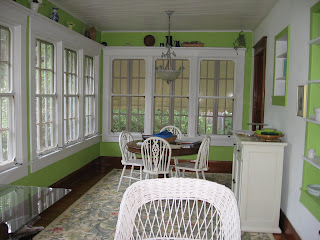 At parties, it's the area where everyone congregates. My friend Paul Gaston tells me that when he dated the Captain's daughter (the Captain built the house) in the 1940's, there was a juke box on that porch and there were teenage dance parties all the time.
It has been said the only problem with the house is that there is no master bedroom. Originally the Captain's bedroom was the whole cockpit of the airplane -- that is to say, there was only one room with a bathroom upstairs, but later that was partitioned off to make two bedrooms in the days when families of four could tolerate only one bathroom. A second bathroom could be added up there. What I used as a bedroom, with a walk of about six feet to the bathroom lovingly remodeled by yours truly is this little 11 x 14 gem on the ground floor.
Enamored as I am of the house, it is for sale by owner, as I have left the area. If making such a big cross-country move is daunting, think about living in the little town that so many think of as a storybook place, the small town U.S.A. they've always dreamed of -- Fairhope. You'll find many Internet sites describing it, and it is often cited as one of the safest retirement communities in the country. Maybe it'll be the perfect place for you.
If you want to discuss this further, contact me at: marylois@gmail.com

Walking distance to downtown Fairhope and the bay! Beautifully landscaped yard with stone walkways will lead you to the front door of this enchanting 1916 cottage. Tastefully renovated, yet has lost none of its original charm.
All of the above is in the description from the flyer created by my realtor for my house. Rhapsodic realtor language, you'll notice, but all true. And there's more. The 1,926-square foot cottage sits on a double lot so there's room for your pets and children to romp before strolling with you to the nearby ice cream shop, or down to the bluff to greet the statue of Marietta Johnson and watch the waves on the bay.
It's a well-built old house (old for Fairhope, that is: built in 1916) with sturdy walls and heart-pine floors that don't creak. It was the cat's meow in its day, an airplane bungalow with two small bedrooms upstairs and a charming one downstairs. There is a spacious front porch from which to watch your neighbors jog by in the morning while sipping your coffee and reading the Swampscum Daily Ooze, the local nickname for Mobile's newspaper. People drop by to ask your opinion on stuff or to comment on local situations, political or otherwise.
Walking back inside is like receiving a warm hug from the past.
 There is a huge fireplace and beadboad ceiling in the 14 x 28 living room. There are the original Craftsman details and built-ins -- along with moldings and trim around the doors and windows, and hardwood floors throughout the house.
There is a light-filled sunporch which can be used as a dining area and is my favorite room in the house, surrounded by three walls of windows, from which you can see trees and shrubs and life in slow-paced, small-town America.
 At parties, it's the area where everyone congregates. My friend Paul Gaston tells me that when he dated the Captain's daughter (the Captain built the house) in the 1940's, there was a juke box on that porch and there were teenage dance parties all the time.
It has been said the only problem with the house is that there is no master bedroom.
 Originally the Captain's bedroom was the whole cockpit of the airplane -- that is to say, there was only one room with a bathroom upstairs, but later that was partitioned off to make two bedrooms in the days when families of four could tolerate only one bathroom. A second bathroom could be added up there. What I used as a bedroom, with a walk of about six feet to the bathroom lovingly remodeled by yours truly is this little 11 x 14 gem on the ground floor.
Enamored as I am of the house, it is for sale by owner, as I have left the area. If making such a big cross-country move is daunting, think about living in the little town that so many think of as a storybook place, the small town U.S.A. they've always dreamed of -- Fairhope. You'll find many Internet sites describing it, and it is often cited as one of the safest retirement communities in the country. Maybe it'll be the perfect place for you.
If you want to discuss this further, contact me at: marylois@gmail.com
Wednesday, August 01, 2007
The Long and Short of Goodbyes
August 2, 2007
I caught just the ending of the 1944 classic National Velvet on Turner Classic Movies yesterday morning and discovered that that sweet film contained a great deal more wisdom than I'd ever realized. When Mi (played by Mickey Rooney) decides to leave, he has a short scene telling Mr. Brown that he's not good at saying goodbye. He says, "Tell Velvet goodbye for me, would you? And Mrs. Brown?" and after a few more words he walks off into the MGM sunset.
When Velvet discovers he's left, her mother explains that it was his time to move on, and he had done so. This is a beautifully written and played scene of parental advice -- elegantly dispensed and actually being taken -- yet Velvet has one more thing to tell him, asks her mother's permission. When she gets it, the girl mounts her steed and rides off to end the film with an exciting canter and finally two silhouettes in the distance. It is a hokey landscape, but it works.
I'm not too good at goodbyes myself. Not for Mi's reason -- being a young fellow and English to boot, he couldn't stand sentimentality, and probably was more than a little uneasy about tears -- with me it's just that I don't really accept the finality. I'm always certain that departing person will always literally be a part of my life, even though I've learned that there are some people I shall never see again. I have a cocoon of denial that gets me through difficult moments, and it sometimes lasts for years. Looking at the photos of the actors from Geneva, say, or recalling some office highjinks from Fairchild Publications in the 1970's, the cast to characters of my memory are as vivid to me as if they had just stepped into the other room for a minute.
I imagine I can find their phone numbers, or look them up on Google -- and reconnect in an instant; and all the intervening years will be wiped away. In some cases I can and have done so. However, more often, although people tend to be cordial and at least give the appearance of being pleasantly surprised to hear from me, I usually soon learn that I am opening a door that may have been better left closed. In my pantheon of old friends, I have to restrain myself from the urge to embrace them all.
I love reunions, and look forward to the upcoming one in Fairhope, but before it happens I must learn to lower my expectations. I must see things from other people's side. I must move on, like Mi.
Although saying goodbye was difficult for Mi, it's the moving on part that is difficult for me. I spoke with an intimate friend of ten years ago on the phone just a few weeks back, trying to catch him up on my life and my plans. Although we occasionally -- perhaps once a year -- meet for drinks or lunch, this time he was cool, and there were background noises from his side that sounded for all the world like giggling young women. He rang off saying, "I'll call you next week." When I hung up I realized I would never hear from him. This sentence resounded in my head: That train has left the station. How long it took me to realize it I'm embarrassed to say, but maybe I learned something with that conversation. Ever since, I catch myself thinking "That train has left the station too."
There are long goodbyes and abrupt ones. The final goodbye of death is easier for me to accept (but not without the requisite stages of grief) than the reality that this person is still walking the earth, but once and for all no longer in my orbit. In my heart, those, "Have-a-nice-life" goodbyes never really happen. But I'm learning to believe in them as I learn to empathize with people who are somehow less needy for their own past.
I don't think it's a bad trait to have the ability to go forward and leave baggage behind. I just say I haven't mastered it yet.
I caught just the ending of the 1944 classic National Velvet on Turner Classic Movies yesterday morning and discovered that that sweet film contained a great deal more wisdom than I'd ever realized. When Mi (played by Mickey Rooney) decides to leave, he has a short scene telling Mr. Brown that he's not good at saying goodbye. He says, "Tell Velvet goodbye for me, would you? And Mrs. Brown?" and after a few more words he walks off into the MGM sunset.
When Velvet discovers he's left, her mother explains that it was his time to move on, and he had done so. This is a beautifully written and played scene of parental advice -- elegantly dispensed and actually being taken -- yet Velvet has one more thing to tell him, asks her mother's permission. When she gets it, the girl mounts her steed and rides off to end the film with an exciting canter and finally two silhouettes in the distance. It is a hokey landscape, but it works.
I'm not too good at goodbyes myself. Not for Mi's reason -- being a young fellow and English to boot, he couldn't stand sentimentality, and probably was more than a little uneasy about tears -- with me it's just that I don't really accept the finality. I'm always certain that departing person will always literally be a part of my life, even though I've learned that there are some people I shall never see again. I have a cocoon of denial that gets me through difficult moments, and it sometimes lasts for years. Looking at the photos of the actors from Geneva, say, or recalling some office highjinks from Fairchild Publications in the 1970's, the cast to characters of my memory are as vivid to me as if they had just stepped into the other room for a minute.
I imagine I can find their phone numbers, or look them up on Google -- and reconnect in an instant; and all the intervening years will be wiped away. In some cases I can and have done so. However, more often, although people tend to be cordial and at least give the appearance of being pleasantly surprised to hear from me, I usually soon learn that I am opening a door that may have been better left closed. In my pantheon of old friends, I have to restrain myself from the urge to embrace them all.
I love reunions, and look forward to the upcoming one in Fairhope, but before it happens I must learn to lower my expectations. I must see things from other people's side. I must move on, like Mi.
Although saying goodbye was difficult for Mi, it's the moving on part that is difficult for me. I spoke with an intimate friend of ten years ago on the phone just a few weeks back, trying to catch him up on my life and my plans. Although we occasionally -- perhaps once a year -- meet for drinks or lunch, this time he was cool, and there were background noises from his side that sounded for all the world like giggling young women. He rang off saying, "I'll call you next week." When I hung up I realized I would never hear from him. This sentence resounded in my head: That train has left the station. How long it took me to realize it I'm embarrassed to say, but maybe I learned something with that conversation. Ever since, I catch myself thinking "That train has left the station too."
There are long goodbyes and abrupt ones. The final goodbye of death is easier for me to accept (but not without the requisite stages of grief) than the reality that this person is still walking the earth, but once and for all no longer in my orbit. In my heart, those, "Have-a-nice-life" goodbyes never really happen. But I'm learning to believe in them as I learn to empathize with people who are somehow less needy for their own past.
I don't think it's a bad trait to have the ability to go forward and leave baggage behind. I just say I haven't mastered it yet.
One More Time: Revive Us Again
August 1, 2007
This, an update of a post placed July 13, 2006:
Every so often a venerable institution undergoes an upheaval followed by a revival of interest, a rebirth, and a reaffirmation of its reason for being. This is slated to happen very soon for a school that was once at the very heart of Fairhope.
The Marietta Johnson School of Organic Education, often referred to as the Organic School, was founded in Fairhope by the visionary educator whose name it bears in 1907. It's about to have a Centennial, and will definitely have a big all-class reunion in October, giving us a chance to talk about a revival.
New things are happening, detailed on the website linked above. The web page may not quite capture is the mysterious spirit that surrounds the school and its offspring. (I think offspring is the right word here; you wouldn't say graduates, because many who love the school the most went there a year or two, sometimes just a semester.)
The Organic School gave us the feeling that school itself may be just a kid's daily job -- but that some days miracles happened. And every day in school was thrilling to some degree. We didn't think about it consciously (unless we observed a miracle) but there was a process of osmosis called learning by doing that accompanied every textbook we read, every map we looked at, every project we worked on. In addition to that, which occurs in every school, was the unstated component in our school that we learned because we wanted to.
In high school, I remember, we put together a newspaper because we wanted to. The students before us had done it and we felt it was our turn. We didn't even have a faculty advisor. Someone showed us how to cut stencils and operate the mimeograph machine, some of us just naturally did the writing, and we had a newspaper. We would stay after school and work on it. Sometimes we came at night and worked until 8 or 9 P.M. to put the paper to bed. Nobody told us to do this; if we hadn't, nothing would have happened. We just never thought of not doing it.
Another example of what Marietta Johnson called "organic education" was when I was in Junior High, probably 7th grade. There was what was laughingly known as a library at the school, containing lots of decrepit old books left there by previous generations. I would read them sometimes just for their time-capsule quality. One I remember reading was about a young lady who was driving a roadster and it got stuck in the mud. I couldn't help thinking how funny it was to read about getting your roadster out of the mud -- and relating to the young people of the 1920's reading this book seriously and thinking of the life they must have had. (A lot of roadsters in Fairhope probably did get stuck in the mud; streets weren't fully paved until the 1960s.)
Anyway, back to the 1950's -- we're browsing around in this antiquated library and we see a bunch of copies of worn playscripts of the works of Shakespeare. There was As You Like It, I remember, and The Merchant of Venice.
It was not a big leap, seeing that there were copies enough for the whole class, to ask the English teacher if she thought we would get anything out of reading those plays. Sure, said the English teacher, and we set out to study them one by one. We wrestled with the verse, wrote essays about the plays, and nobody thought twice about what was in the Alabama Course of Study for 7th or 8th Grade. I remember years later coming on a theme I wrote at that time entitled "Why I Like Shylock." Wish I had saved it. I wonder why I liked Shylock. I think I was just trying to be shocking, but maybe I made a valid point or two in the process.
Now flash-forward again to the Organic Revival. What lies in the immediate future is a reunion of all classes, to be held over the October 5-7 weekend. Marietta Johnson's birthday -- officially Marietta Johnson Day in Fairhope, is October 8. There will be events all weekend, from the pot luck gathering Friday night until the last visitor leaves on Monday. We'll hear talks about the history of Fairhope and the school, students armed with videocams will record our memories of what we got from our Organic Educations and what we can do to ensure a solvent school for the next few centuries. It means a great deal to a lot of us.
We have a fair hope of success for the future, and a spirit and heritage of miracles from the past that cannot be ignored. If near-term coming events help boost a revival, hallelujah! We are saved, brother. Revive us again.
This, an update of a post placed July 13, 2006:
Every so often a venerable institution undergoes an upheaval followed by a revival of interest, a rebirth, and a reaffirmation of its reason for being. This is slated to happen very soon for a school that was once at the very heart of Fairhope.
The Marietta Johnson School of Organic Education, often referred to as the Organic School, was founded in Fairhope by the visionary educator whose name it bears in 1907. It's about to have a Centennial, and will definitely have a big all-class reunion in October, giving us a chance to talk about a revival.
New things are happening, detailed on the website linked above. The web page may not quite capture is the mysterious spirit that surrounds the school and its offspring. (I think offspring is the right word here; you wouldn't say graduates, because many who love the school the most went there a year or two, sometimes just a semester.)
The Organic School gave us the feeling that school itself may be just a kid's daily job -- but that some days miracles happened. And every day in school was thrilling to some degree. We didn't think about it consciously (unless we observed a miracle) but there was a process of osmosis called learning by doing that accompanied every textbook we read, every map we looked at, every project we worked on. In addition to that, which occurs in every school, was the unstated component in our school that we learned because we wanted to.
In high school, I remember, we put together a newspaper because we wanted to. The students before us had done it and we felt it was our turn. We didn't even have a faculty advisor. Someone showed us how to cut stencils and operate the mimeograph machine, some of us just naturally did the writing, and we had a newspaper. We would stay after school and work on it. Sometimes we came at night and worked until 8 or 9 P.M. to put the paper to bed. Nobody told us to do this; if we hadn't, nothing would have happened. We just never thought of not doing it.
Another example of what Marietta Johnson called "organic education" was when I was in Junior High, probably 7th grade. There was what was laughingly known as a library at the school, containing lots of decrepit old books left there by previous generations. I would read them sometimes just for their time-capsule quality. One I remember reading was about a young lady who was driving a roadster and it got stuck in the mud. I couldn't help thinking how funny it was to read about getting your roadster out of the mud -- and relating to the young people of the 1920's reading this book seriously and thinking of the life they must have had. (A lot of roadsters in Fairhope probably did get stuck in the mud; streets weren't fully paved until the 1960s.)
Anyway, back to the 1950's -- we're browsing around in this antiquated library and we see a bunch of copies of worn playscripts of the works of Shakespeare. There was As You Like It, I remember, and The Merchant of Venice.
It was not a big leap, seeing that there were copies enough for the whole class, to ask the English teacher if she thought we would get anything out of reading those plays. Sure, said the English teacher, and we set out to study them one by one. We wrestled with the verse, wrote essays about the plays, and nobody thought twice about what was in the Alabama Course of Study for 7th or 8th Grade. I remember years later coming on a theme I wrote at that time entitled "Why I Like Shylock." Wish I had saved it. I wonder why I liked Shylock. I think I was just trying to be shocking, but maybe I made a valid point or two in the process.
Now flash-forward again to the Organic Revival. What lies in the immediate future is a reunion of all classes, to be held over the October 5-7 weekend. Marietta Johnson's birthday -- officially Marietta Johnson Day in Fairhope, is October 8. There will be events all weekend, from the pot luck gathering Friday night until the last visitor leaves on Monday. We'll hear talks about the history of Fairhope and the school, students armed with videocams will record our memories of what we got from our Organic Educations and what we can do to ensure a solvent school for the next few centuries. It means a great deal to a lot of us.
We have a fair hope of success for the future, and a spirit and heritage of miracles from the past that cannot be ignored. If near-term coming events help boost a revival, hallelujah! We are saved, brother. Revive us again.
Saturday, July 28, 2007
The Autobiographical Urge
July 28, 2007
A year ago I was approached by a man in his late 80's about ghostwriting his autobiography. He had lived a rich and varied life and loved to tell stories of his accomplishments and crises. He had coped with great success and tragedy, and about all he had not done was chronicle the events.
He had known lots of interesting people and been in very high places in his day; he sent me a packet of snapshots and newspaper articles about his life. Pictures revealed that he was a good-looking man, movie star good-looking in his youth, and the articles told of the fortune he had made in dealing with big corporations, selling the rights to his inventions and occasionally suing for large sums when his invention ideas were stolen. I was interested in his story, and felt that I would be good as a ghostwriter. I was up for the job. I encouraged him, admonishing only that he would have to be very open with me about some of the life situations in the newspaper items, situations that still might cause him some pain.
He would have had to relocate to be interviewed, or pay for my expenses if I had to travel. He would have to be candid. I would agree to work for him at a fixed rate for about six months, including writing time, and then submit what I had written for his approval. I would not be the salesman for the work, but I felt certain that with his lively personality and his truly unusual life story we could come up with a book that would sell.
I laid out the proposal and waited. Time passed, and he passed off my radar screen, by not acting. He probably thought better of the project and did not want to be under this kind of stress at this point in his life, no matter how strong his urge to be immortalized in print. I never received a refusal, but I had lobbed the ball to his court and it had not been returned.
I didn't blame him. For years he had probably regaled friends and acquaintances with tales of his childhood inventions, his successes and near-successes, and the odd and unexpected turns his life had taken. He was probably told by many an acquaintance, "You really should write a book about all this," but the reality of such a venture was not one he could handle.
An urge to write hits us as we grow closer to what we perceive as the end of life. There is a need to get it down in black and white, this little life, before it's gone. I can understand this myself, hacking away at a daily blog and thinking of books I must get done. My mother, always an admirer of writers (and married to a first-rate one), spent years researching a family history that including anecdotal tales going all the way back to family members who gave Robert the Bruce of Scotland a ride across the river in the middle of a war -- being awarded in later years with a coat of arms that read "I Saved the King." She completed her family history in the and self-published it in 1994 after almost 20 years of exhaustive research, and the result is a book that reflects all the charm of its writer and is constantly used as research by her three grown children. She printed copies for all living members of the family and distributed this work to as many of them as she knew.
Her little book is a treasure trove of information about our ancestors. It was a project that consumed her as she edged into old age, and a copy of it is in her bureau at the nursing home. She sometimes mentions it ("the book I wrote") and we sometimes pick it up to confirm a birth date or year, or cause of death, or any little piece of family information we could get nowhere else.
It is good that much of mankind is equipped with this autobiographical urge. Blogs are a great tool for this very thing. As to those who are not compelled to write, of course they create and contribute in many ways. But the actual stories, even with a very personal slant, are the stuff of life and the best we can do toward carving a place in the mythology of generations to come.
A year ago I was approached by a man in his late 80's about ghostwriting his autobiography. He had lived a rich and varied life and loved to tell stories of his accomplishments and crises. He had coped with great success and tragedy, and about all he had not done was chronicle the events.
He had known lots of interesting people and been in very high places in his day; he sent me a packet of snapshots and newspaper articles about his life. Pictures revealed that he was a good-looking man, movie star good-looking in his youth, and the articles told of the fortune he had made in dealing with big corporations, selling the rights to his inventions and occasionally suing for large sums when his invention ideas were stolen. I was interested in his story, and felt that I would be good as a ghostwriter. I was up for the job. I encouraged him, admonishing only that he would have to be very open with me about some of the life situations in the newspaper items, situations that still might cause him some pain.
He would have had to relocate to be interviewed, or pay for my expenses if I had to travel. He would have to be candid. I would agree to work for him at a fixed rate for about six months, including writing time, and then submit what I had written for his approval. I would not be the salesman for the work, but I felt certain that with his lively personality and his truly unusual life story we could come up with a book that would sell.
I laid out the proposal and waited. Time passed, and he passed off my radar screen, by not acting. He probably thought better of the project and did not want to be under this kind of stress at this point in his life, no matter how strong his urge to be immortalized in print. I never received a refusal, but I had lobbed the ball to his court and it had not been returned.
I didn't blame him. For years he had probably regaled friends and acquaintances with tales of his childhood inventions, his successes and near-successes, and the odd and unexpected turns his life had taken. He was probably told by many an acquaintance, "You really should write a book about all this," but the reality of such a venture was not one he could handle.
An urge to write hits us as we grow closer to what we perceive as the end of life. There is a need to get it down in black and white, this little life, before it's gone. I can understand this myself, hacking away at a daily blog and thinking of books I must get done. My mother, always an admirer of writers (and married to a first-rate one), spent years researching a family history that including anecdotal tales going all the way back to family members who gave Robert the Bruce of Scotland a ride across the river in the middle of a war -- being awarded in later years with a coat of arms that read "I Saved the King." She completed her family history in the and self-published it in 1994 after almost 20 years of exhaustive research, and the result is a book that reflects all the charm of its writer and is constantly used as research by her three grown children. She printed copies for all living members of the family and distributed this work to as many of them as she knew.
Her little book is a treasure trove of information about our ancestors. It was a project that consumed her as she edged into old age, and a copy of it is in her bureau at the nursing home. She sometimes mentions it ("the book I wrote") and we sometimes pick it up to confirm a birth date or year, or cause of death, or any little piece of family information we could get nowhere else.
It is good that much of mankind is equipped with this autobiographical urge. Blogs are a great tool for this very thing. As to those who are not compelled to write, of course they create and contribute in many ways. But the actual stories, even with a very personal slant, are the stuff of life and the best we can do toward carving a place in the mythology of generations to come.
Friday, July 27, 2007
Real Woman, Fair Hope
July 27
I think it’s time for a real woman to be President of the United States. I say this somewhat defensively because it is assumed that since I cannot support Hillary Clinton, I am one of the ones who is somehow just not ready.
I have a certain amount of respect for Senator Clinton. I don’t deny that she has great intelligence and drive. I like to see the pictures of her laughing, and I don’t doubt that she enjoys a good joke every once in a while. She has presence and self-confidence. She is tough. But try as I might, I cannot find one thing authentic about her.
She speaks in platitudes (or, as they say, soundbites). This means she seems to be talking but nothing definitive is said or clarified. It’s designed to be clipped out and run on the evening news.
She never makes it clear where she stands on issues – any issues. She’s just being a politician, her supporters say. The Right paints her as a flaming Liberal, the Left as a middle-of-the-roader; in reality she will say whatever it takes to seem reasonable. But she doesn’t convince me. I can’t say I know anything about where she stands on matters vital to the leadership of this troubled land.
Take the war. She voted for it because she was lied to, as all of us were. Why is it so hard to say that vote was a mistake? Is she afraid to be called a flip-flopper? What kind of nonsense is that? “Flip-flopper” is a Madison Avenue term that means no more than a person who has changed his or her mind. It’s no disgrace to change one’s mind; in fact, that is an admirable trait as long as it doesn’t get out of hand. In my lifetime I have seen the birth of a new phenomenon – politicians being led around by the nose by their ad agencies. It is these ad agencies who created the phenomenon of focus groups to take the temperature of the public on every product in the marketplace, including, God help us, people who happen to be running for office.
I have been ready for a woman President long before most people can remember. For years there have been a few strong women pretty highly placed in political office. One even ran for President.
I’d have supported Shirley Chisholm if had lived long enough to run today even though she wrote, when she ran for the office in 1972: "I am a candidate for the Presidency of the United States. I make that statement proudly, in the full knowledge that, as a black person and as a female person, I do not have a chance of actually gaining that office in this election year. I make that statement seriously, knowing that my candidacy itself can change the face and future of American politics — that it will be important to the needs and hopes of every one of you — even though, in the conventional sense, I will not win."
Ms. Chisholm was wise, charismatic, brilliant and brave. She did not evade when asked where she stood on the issues. She was the right person, but at the wrong place in the wrong time. She was unique and the country was not ready for her. I’m sorry to say that, since I had voted for Dick Gregory in the 1968 election and was persuaded by my colleagues that my vote had put Richard Nixon in the White House, I chose McGovern over Chisholm in order to get Nixon out. Seeing how successful that kind of thinking was, I have voted my conscience ever since, almost never going for a candidate from either major party.
I’d love to see someone like Bella Abzug back in politics. The country’s first Jewish Congresswoman, she didn’t worry about how she looked or what group might be offended if she opened her mouth. She was a true Feminist who didn’t worry about appearing feminine. She shot from the hip, and got more flack about her hats than about her policies. She once said, “The inside operation of Congress -- the deals, the compromises, the selling out, the co-opting, the unprincipled manipulating, the self-serving career-building -- is a story of such monumental decadence that I believe if people find out about it they will demand an end to it.” If she had had focus groups her candidacy for anything would have been dead on arrival – or she might not even have arrived.
A few years later I supported Arizona State Member of the U.S. House of Representatives Pat Schroeder in her short-lived bid for the Democratic nomination for President. Schroeder couldn’t raise sufficient funds, and apparently didn’t have the fire in the belly necessary to stick it out. She was bright, inspiring, and witty, coining the phrase “The Teflon President” about Ronald Reagan. She also said, “America is man enough to elect a woman President.”
I agree with that. But let’s wait until a real woman runs.
I think it’s time for a real woman to be President of the United States. I say this somewhat defensively because it is assumed that since I cannot support Hillary Clinton, I am one of the ones who is somehow just not ready.
I have a certain amount of respect for Senator Clinton. I don’t deny that she has great intelligence and drive. I like to see the pictures of her laughing, and I don’t doubt that she enjoys a good joke every once in a while. She has presence and self-confidence. She is tough. But try as I might, I cannot find one thing authentic about her.
She speaks in platitudes (or, as they say, soundbites). This means she seems to be talking but nothing definitive is said or clarified. It’s designed to be clipped out and run on the evening news.
She never makes it clear where she stands on issues – any issues. She’s just being a politician, her supporters say. The Right paints her as a flaming Liberal, the Left as a middle-of-the-roader; in reality she will say whatever it takes to seem reasonable. But she doesn’t convince me. I can’t say I know anything about where she stands on matters vital to the leadership of this troubled land.
Take the war. She voted for it because she was lied to, as all of us were. Why is it so hard to say that vote was a mistake? Is she afraid to be called a flip-flopper? What kind of nonsense is that? “Flip-flopper” is a Madison Avenue term that means no more than a person who has changed his or her mind. It’s no disgrace to change one’s mind; in fact, that is an admirable trait as long as it doesn’t get out of hand. In my lifetime I have seen the birth of a new phenomenon – politicians being led around by the nose by their ad agencies. It is these ad agencies who created the phenomenon of focus groups to take the temperature of the public on every product in the marketplace, including, God help us, people who happen to be running for office.
I have been ready for a woman President long before most people can remember. For years there have been a few strong women pretty highly placed in political office. One even ran for President.

I’d have supported Shirley Chisholm if had lived long enough to run today even though she wrote, when she ran for the office in 1972: "I am a candidate for the Presidency of the United States. I make that statement proudly, in the full knowledge that, as a black person and as a female person, I do not have a chance of actually gaining that office in this election year. I make that statement seriously, knowing that my candidacy itself can change the face and future of American politics — that it will be important to the needs and hopes of every one of you — even though, in the conventional sense, I will not win."
Ms. Chisholm was wise, charismatic, brilliant and brave. She did not evade when asked where she stood on the issues. She was the right person, but at the wrong place in the wrong time. She was unique and the country was not ready for her. I’m sorry to say that, since I had voted for Dick Gregory in the 1968 election and was persuaded by my colleagues that my vote had put Richard Nixon in the White House, I chose McGovern over Chisholm in order to get Nixon out. Seeing how successful that kind of thinking was, I have voted my conscience ever since, almost never going for a candidate from either major party.
I’d love to see someone like Bella Abzug back in politics.
 The country’s first Jewish Congresswoman, she didn’t worry about how she looked or what group might be offended if she opened her mouth. She was a true Feminist who didn’t worry about appearing feminine. She shot from the hip, and got more flack about her hats than about her policies. She once said, “The inside operation of Congress -- the deals, the compromises, the selling out, the co-opting, the unprincipled manipulating, the self-serving career-building -- is a story of such monumental decadence that I believe if people find out about it they will demand an end to it.” If she had had focus groups her candidacy for anything would have been dead on arrival – or she might not even have arrived.
A few years later I supported Arizona State Member of the U.S. House of Representatives Pat Schroeder in her short-lived bid for the Democratic nomination for President. Schroeder couldn’t raise sufficient funds, and apparently didn’t have the fire in the belly necessary to stick it out. She was bright, inspiring, and witty, coining the phrase “The Teflon President” about Ronald Reagan. She also said, “America is man enough to elect a woman President.”
I agree with that. But let’s wait until a real woman runs.
Thursday, July 26, 2007
The Heat of Summer
July 26, 2007
If you once lived in Fairhope and have relocated to somewhere else -- anywhere else -- you wonder how anyone ever tolerated the hot summers we have here. I remember talking to an old friend in the mountains of Switzerland. He then lived in Rhode Island.
I said, "It was so humid there! I don't think I was ever completely dry until I was 30 years old."
He said, "I remember one night in particular."
"Oh, yes!" said I. "It was even hot at night! People don't believe me when I tell them how hot it was at night."
"One night I couldn't sleep. We had fans, we had ice water, wet towels, showers, everything we could think of. But this night I woke up so hot nothing worked. I went out in the yard, looking for a breeze."
"I did that too! I remember doing that one night!"
To put a pinpoint on it, this night was probably in August of the year 1951. Maybe 1952. The weather service would have records. I've had the above discussion with a number of friends, all roughly of my vintage, and we all describe one sweltering night long after our families were asleep and we were suffering from the unbearable heat. We walked out into our yards, wailed at the moon, or prayed to God for relief, fell into the hammocks or the lawn furniture, yearning for a spot somewhere that was not so still and hot. All the county, to hear us describe it, must have been swarming with lawns full of little kids falling into hammocks or leaning on the tire swings and moaning.
It is now the middle of July. We can expect that kind of weather for weeks to come. It's just that when it gets here, it stays. There is no "cool snap." Summer has come like a warm damp blanket and you are trapped.
At least today nobody suffers. There is air conditioning. Nobody would dream of going outside looking for a gust of breeze, not even an ignorant little kid. We don't go into the natural air except for emergencies when we have to brave those few moments between the air conditioning of the house and the air conditioning of the car. Outdoor living, pictured so elegantly in the catalogues for outdoor furniture and television shows which feature recipes to be cooked on the grill, is not even attempted in the buggy, muggy Deep South. Our porches tend to be glassed in.
The weather forecast suggests lows in the 70's at night. We will probably keep that air conditioner going at night. Because with the humidity, if you don't want to end up out on the lawn in sight of a lot of little phantom moaning little kids, you're going to need conditioned air all the time if you want to sleep.
It's summer in the deep South.
If you once lived in Fairhope and have relocated to somewhere else -- anywhere else -- you wonder how anyone ever tolerated the hot summers we have here. I remember talking to an old friend in the mountains of Switzerland. He then lived in Rhode Island.
I said, "It was so humid there! I don't think I was ever completely dry until I was 30 years old."
He said, "I remember one night in particular."
"Oh, yes!" said I. "It was even hot at night! People don't believe me when I tell them how hot it was at night."
"One night I couldn't sleep. We had fans, we had ice water, wet towels, showers, everything we could think of. But this night I woke up so hot nothing worked. I went out in the yard, looking for a breeze."
"I did that too! I remember doing that one night!"
To put a pinpoint on it, this night was probably in August of the year 1951. Maybe 1952. The weather service would have records. I've had the above discussion with a number of friends, all roughly of my vintage, and we all describe one sweltering night long after our families were asleep and we were suffering from the unbearable heat. We walked out into our yards, wailed at the moon, or prayed to God for relief, fell into the hammocks or the lawn furniture, yearning for a spot somewhere that was not so still and hot. All the county, to hear us describe it, must have been swarming with lawns full of little kids falling into hammocks or leaning on the tire swings and moaning.
It is now the middle of July. We can expect that kind of weather for weeks to come. It's just that when it gets here, it stays. There is no "cool snap." Summer has come like a warm damp blanket and you are trapped.
At least today nobody suffers. There is air conditioning. Nobody would dream of going outside looking for a gust of breeze, not even an ignorant little kid. We don't go into the natural air except for emergencies when we have to brave those few moments between the air conditioning of the house and the air conditioning of the car. Outdoor living, pictured so elegantly in the catalogues for outdoor furniture and television shows which feature recipes to be cooked on the grill, is not even attempted in the buggy, muggy Deep South. Our porches tend to be glassed in.
The weather forecast suggests lows in the 70's at night. We will probably keep that air conditioner going at night. Because with the humidity, if you don't want to end up out on the lawn in sight of a lot of little phantom moaning little kids, you're going to need conditioned air all the time if you want to sleep.
It's summer in the deep South.
Friday, July 20, 2007
Manhattan 2 Hoboken, Commute Delayed
July 20, 2007
I wonder sometimes what the difference is between living in Fairhope and living in Hoboken -- besides the obvious one of looking across the river at the Empire State Building and looking across the bay and barely being able to discern anything like a skyline.
This reminds me of the time I showed Martin Platt, then Director of the Alabama Shakespeare Festival, around Fairhope. His first reaction -- and this was in 1990 -- "This town has a case of the cutes," but he later said Fairhope would be livable "If only that were Toronto on the other side of that bay."
But I digress. In Hoboken, it's better than having Toronto across the nearby water. You have the city that never sleeps, the home of heart of the arts and commerce of America, the crown jewel of our country. (Okay, there are some drawbacks to NYC; there are problems. But give me a little leeway here. It's more interesting than Mobile.)
I am boning up on Hoboken. I'm checking out its history on the web. I'm reading the Hoboken blogs. Yesterday I found a very interesting post on a solid blog called Philly2Hoboken that described the ordeal of living through the steam pipe break and trying to get home to Hoboken. It brought it back to me what living in the city is like -- the uncertainty, the uneasiness in crisis, and the general atmosphere when you and your neighbors are drawn together in a way that nobody likes. I lived in New York in the 1960's and 70's and the worst situation we had to deal with was a blackout or two. Who knows what will be next, or how bad it will be?
The writer of Philly2Hoboken wove his way by cab to the ferry, trying to get over the river in the most expedient way possible. His commute is usually little more than ten minutes; on this day it was over two hours. But after enduring the inefficiency of waiting in long lines, looking for a ticket machine that didn't exist, he enjoyed the cool breezes on the ferry, and, although it docked at a place a long way from where he lived, he was able to get a bus to his home with no trouble.
A bus to his home! We don't have things like that in Fairhope or even Mobile. I can shed my car before I leave. I can get a train into and out of the city most days (and have the ferry option in certain emergencies or just when I feel like it).
Reading his blogpost, I could feel his relief at getting home to Hoboken. I can almost feel how I'm going to feel in the same situation.
I wonder sometimes what the difference is between living in Fairhope and living in Hoboken -- besides the obvious one of looking across the river at the Empire State Building and looking across the bay and barely being able to discern anything like a skyline.
This reminds me of the time I showed Martin Platt, then Director of the Alabama Shakespeare Festival, around Fairhope. His first reaction -- and this was in 1990 -- "This town has a case of the cutes," but he later said Fairhope would be livable "If only that were Toronto on the other side of that bay."
But I digress. In Hoboken, it's better than having Toronto across the nearby water. You have the city that never sleeps, the home of heart of the arts and commerce of America, the crown jewel of our country. (Okay, there are some drawbacks to NYC; there are problems. But give me a little leeway here. It's more interesting than Mobile.)
I am boning up on Hoboken. I'm checking out its history on the web. I'm reading the Hoboken blogs. Yesterday I found a very interesting post on a solid blog called Philly2Hoboken that described the ordeal of living through the steam pipe break and trying to get home to Hoboken. It brought it back to me what living in the city is like -- the uncertainty, the uneasiness in crisis, and the general atmosphere when you and your neighbors are drawn together in a way that nobody likes. I lived in New York in the 1960's and 70's and the worst situation we had to deal with was a blackout or two. Who knows what will be next, or how bad it will be?
The writer of Philly2Hoboken wove his way by cab to the ferry, trying to get over the river in the most expedient way possible. His commute is usually little more than ten minutes; on this day it was over two hours. But after enduring the inefficiency of waiting in long lines, looking for a ticket machine that didn't exist, he enjoyed the cool breezes on the ferry, and, although it docked at a place a long way from where he lived, he was able to get a bus to his home with no trouble.
A bus to his home! We don't have things like that in Fairhope or even Mobile. I can shed my car before I leave. I can get a train into and out of the city most days (and have the ferry option in certain emergencies or just when I feel like it).
Reading his blogpost, I could feel his relief at getting home to Hoboken. I can almost feel how I'm going to feel in the same situation.
Sunday, July 15, 2007
Progress

July 15, 2007
When does the Fairhope Walmart open? Ah, that is the question.
About ten years ago I was on the Fairhope Historic Preservation Committee. I've mentioned this before on the blog.
Our purpose in those days was to celebrate the history of Fairhope and preserve its look of early 20th Century America. We created a tour of homes, showcasing the cottages that once exemplified Fairhope's early days. We saw change coming, but all the new people professed to love the little bungalows and the charm of the patchwork nature of the streetscapes. Some of us remembered the days when all the streets were not paved and children played in the gulleys in their many spare hours.
We found the preservation of the houses and old buildings themselves a hard sell with the business community of Fairhope, so we vowed to elect a mayor who was sensitive to Fairhope's past and try to get a few of our own members on the city council.
This did come to pass in the mid 1990's. A long-term Comprehensive City Plan was devised with the help of consultants, and a historic preservation ordinance was presented to the mayor who promised to help us get it passed. It was in the Comprehensive Plan that the city would be zoned to encourage neighborhood stores and no "big-box" stores would be built within the city limits. All this was considered a coup for our side, creating a small town of walkers, getting exercise in the fresh air and not impinged upon by the dreaded Wal-Marts and other chains. Ultimately all these good intentions came to naught.
The Historic Preservation Ordinance was cast into the wastebin as soon as the mayor heard a few objections. Cottages were demolished and replaced by very large, very expensive homes, almost all designed by the same local architectural firm, and all looking very much alike -- way too big for the lots on which they sat, very imposing and designed (totally unlike the Fairhope equalizing philosophy) to impress the neighbors and the world at large.
By the time the new Walmart was announced, just outside the city limits, a few people, maybe as many as a hundred, picketed with homemade signs announcing "No Walmart in Fairhope" and a great deal of media coverage accompanied them. Technically they didn't have a leg to stand on since the Walmart was not actually "in" Fairhope. A Sam's Club was on the way up in nearby Loxley, and another Walmart is slated to be built in Robertsdale, which will certainly meet with a warmer reception than the one here.
The most hits I get on this blog these days come from the search words "When does Fairhope Walmart open?" I can report that I don't know exactly when it will open. It hasn't been in the newspapers (or on television) yet. But I've been out to the site to snap the photo above, which shows the building completed and a lot of activity therein.
I am not against this development any more than I am "for" it. I don't much like Walmart, and don't frequent the one in nearby Daphne, but I have no doubt this one will have a lot of traffic and that most locals will be pleased to have it so convenient. It's not one of my causes, as historic preservation was. It's just a fact of life. And it will be a fact of Fairhope life any day now.
Monday, July 09, 2007
The Little Theater of Geneva
 |
| Reg Bird, Mary Lois Adshead in Forty Carats |
They're all in boxes now, photos of the many plays I worked on in Geneva back in the 1980s. It started as a lark, a Monday evening activity at the American Women's Club, sitting around a table reading plays. After a few months of this, one of our regulars suggested, "It's time to mount a production."
If memory serves me it was Bob Hinely, a personnel guy at the Du Pont company and longtime amateur actor, who made that suggestion. He said, "Reading plays is fun, but if this is going anywhere, we've got to get a stage and put on a show."
He was right. I had been an actress in New York, studied with Peggy Feury and her mentor Lee Strasberg, and had been in plays since I was a teenager in Fairhope. I had worked backstage a little, but what I really wanted to do was direct -- so all the pieces fell in place to get something started. I had been on the board of Geneva's English Drama Society (GEDS), but when I didn't get re-elected to that I decided to produce American plays with the American Women's Club.
We started with an evening of one-acts, which went off pretty well. Then we held auditions and began planning a full-scale production. The play I chose was the old chestnut The Man Who Came To Dinner.
 It had a cast of 28 people! This was a way to get ourselves known in the American community of Geneva -- I cast the minister at the American Church as a delivery man, and the Vice President of the American Women's Club as a television newscaster. I updated the script ("Hamilton Fish" became "Prince Andrew," "Gertrude Stein" became "Frank Sinatra," that sort of thing). What I didn't know when doing that was that every single celebrity name dropped in the play became a laugh line in the show -- and there were lots of them. Here we see Dorothy Watkins as the actress charming Keith Kentopp as Whiteside.
 |
| Jim Buckner, Dorothy Watkins in The Little Foxes |
 |
| Reg Bird, Julian Finn In Tribute |
Ronnie later directed a first-rate production of Deathtrap in Geneva. We all had great fun.
The Little Theatre changed lives. Reg moved back to Michigan where he and his family produce summer theatre on Torch Lake. Ronnie has written plays and movie scripts. More than that, we offered something unique in Switzerland, and we had as almost many Swiss in the audience as we had Americans. There is nothing quite like the theatre of a country and how it represents everything about that country. We were an outpost of American culture as well as the best of the American attitude that if-you-want-to-do-it, you-can! We made friends and we made memories.
I hope someone looking up Little Theatre of Geneva finds this blog post and adds a comment. Wherever you are, you remember all that we did. It's one project that will live in my memory, and that I'll always be proud of.
Thursday, July 05, 2007
Friends in New Places
July 5, 2007
I've still got one foot in Fairhope, but I've got the big toe of the other in Hoboken. I check Craigslist every day to see what's for rent there -- even though it will be months before I'll have any need to follow up; we all have our little compulsions -- and I go to the official Hoboken website and many of the blogs serving the area to get a feel for the place.
I get the distinct sense that there's a lot of testosterone in Hoboken. There is an air of conflict and aggression about the place, an atmosphere not prevalent in small cities in the South. I've visited a couple of Hoboken blogs and made comments there. I've gotten responses. One of them even posted about my plans to move and that elicited a few advice comments.
The writer of that blog, Jeff Fario, wondered if my attraction to Hoboken was a mistaken association with New Orleans. Hadn't thought of that at all -- it seemed sort of European to me, with that wide main street, and all the shops and neighborhood bakeries (and Catholic churches), which New Orleans does, but more distinctly Italian-American. It had more diversity than Fairhope, and more youth. It had a lot more bars, but my days of hanging out in bars for any period of time are pretty much behind me. (Thank God and AA I survived!)

The shop above, with Xmas tree lights and hanging pots, plus its very American sign above the door, spoke to me of Hoboken. You wouldn't see that around here in Lower Alabama. It had a blatant tackiness that was charming without trying. It didn't look like somebody's idea of Art, but it got my attention. There are lots more picturesque views of Hoboken, more elegant ones and more upscale ones. But here and there are touches of a simple bygone day, like the sign in shape of a hand pointing to "The Clam Broth House," which is no longer there. I hope they leave the sign up forever. (If I were running an Italian restaurant, what would make me think to celebrate clam broth anyway? What's so great about clam broth, in the galaxy of tasty Italian food? Maybe somebody in Hoboken will be able to tell me.)
There's a chance I won't meet any of the guys who write Hoboken blogs. Or that if we do we won't particularly hit it off. I just like knowing they're there, and I like their feisty, macho Hoboken take on things.
And the fact that they're in cyberspace lets me visit my own virtual reality of Hoboken while still living amid the spectacular sunsets and painted pelicans.
I've still got one foot in Fairhope, but I've got the big toe of the other in Hoboken. I check Craigslist every day to see what's for rent there -- even though it will be months before I'll have any need to follow up; we all have our little compulsions -- and I go to the official Hoboken website and many of the blogs serving the area to get a feel for the place.
I get the distinct sense that there's a lot of testosterone in Hoboken. There is an air of conflict and aggression about the place, an atmosphere not prevalent in small cities in the South. I've visited a couple of Hoboken blogs and made comments there. I've gotten responses. One of them even posted about my plans to move and that elicited a few advice comments.
The writer of that blog, Jeff Fario, wondered if my attraction to Hoboken was a mistaken association with New Orleans. Hadn't thought of that at all -- it seemed sort of European to me, with that wide main street, and all the shops and neighborhood bakeries (and Catholic churches), which New Orleans does, but more distinctly Italian-American. It had more diversity than Fairhope, and more youth. It had a lot more bars, but my days of hanging out in bars for any period of time are pretty much behind me. (Thank God and AA I survived!)

The shop above, with Xmas tree lights and hanging pots, plus its very American sign above the door, spoke to me of Hoboken. You wouldn't see that around here in Lower Alabama. It had a blatant tackiness that was charming without trying. It didn't look like somebody's idea of Art, but it got my attention. There are lots more picturesque views of Hoboken, more elegant ones and more upscale ones. But here and there are touches of a simple bygone day, like the sign in shape of a hand pointing to "The Clam Broth House," which is no longer there. I hope they leave the sign up forever. (If I were running an Italian restaurant, what would make me think to celebrate clam broth anyway? What's so great about clam broth, in the galaxy of tasty Italian food? Maybe somebody in Hoboken will be able to tell me.)
There's a chance I won't meet any of the guys who write Hoboken blogs. Or that if we do we won't particularly hit it off. I just like knowing they're there, and I like their feisty, macho Hoboken take on things.
And the fact that they're in cyberspace lets me visit my own virtual reality of Hoboken while still living amid the spectacular sunsets and painted pelicans.
Saturday, June 30, 2007
Cottage For Sale

June 30, 2007
As of next week, it will be official. The Captain's House will have a For Sale sign in front, be listed on the local MLS, and the traffic of looky-loo's will begin in earnest.
The 1,900-square-foot cottage is a genuine Fairhope treasure, not that that means much these days. Built in 1916 by Ed Roberts, one of the bay boat pilots, it was solidly constructed and has an ambiance of bygone days that suggests the comfort of a warm hug. I've lived in it for four years and put more money into shoring it up and bringing it up to date than I like to think about. The house has meant a lot to me, and I thought it was likely to be where I ended my days -- until I woke up one day and my life had changed so I decided to put it on the market.
I'm not being realistic about the price, because I hope someone will really appreciate the house and its location. Like everyone in Fairhope, I don't believe in the principle of Single Tax any more, particularly when it comes to selling my own house. Part of this is because I know if I don't ask top dollar, a buyer seeking to flip the property will end up buying low, tearing the house down and selling high, and I will be the loser. Fairhope itself has been the loser in this game for many years now. If it doesn't look as if I can sell the house for my price, down will come the house and the beautiful two lots will be sold separately for a pretty penny. It might as well be me who gets the penny.
I don't feel one way or the other about this. Ever since I moved in I've sought to make an example of the captain's house: This is what old Fairhope looks like. You can do it too. Buy an old house and bring it gently up to date. I've been happy in hog heaven -- making a statement by the way I lived and hoping that statement would set an example in the town I grew up in and once loved. Seeing the fallacy of that has been frustrating almost to the point of heartbreak. Of course Fairhope is not what it used to be, but it is what it is. It is in a transition, becoming something else entirely. I just don't choose to stay around and be a part of it.
You'll read more about this here in days to come. In a way I wish things were different. But for me anyway, they will be. I'm moving to Hoboken.
Thursday, June 28, 2007
The Pelican Legend

June 28, 2007
Fairhope is known as an artists' colony. It never was one, but it once had a few real artists. Now it has an Art Association, mainly made up of hobby artists and offering classes in painting, sculpture and pottery to the general public. This club is very successful, and has spawned a few artists, to be sure. It's just that their idea of art does not quite coincide with mine.
An offshoot of the Art Association is a committee called the Committee for Public Art. This came into being after the Marietta Johnson Museum raised funds for a statue of Marietta Johnson, a very simple, tasteful piece with three figures, slightly larger than life, one being Mrs. Johnson herself and the other two being children who are learning from her. After the erection of this statue the Committee for Public Art went into action and raised money for a statue of "The Spirit of Fairhope." This work, an abstract, three-pronged piece in blue, stands at the entrance to the town, just across the street from the Art Association building. The committee has sponsored a number of projects, including sculpture of a couple of dolphins, a sea horse, and I don't know what else. Until the pelicans.
In the days when Fairhope didn't think of itself as an artists' colony, but rather a Single Tax Colony, we had an artist-craftsman in residence named Craig Sheldon who made his living in the construction trade. Craig was a wood-carver who occasionally got commissions to create sculpture. He created whimsical animals and occasional political whimsies out of wood, and built his own house in the form of a tiny castle, out of local tile, stone, and found objects. He raised three children and lived a rather astonishing life in his little corner of Fairhope.
At the end of his life -- I believe he was in his 80's and suffering from Altzheimer's -- he was commissioned to create a sculpture to go in the new fountain at the community college. The result is the statue of pelicans you see above. It was not Craig's best work, but it had a sense of wonder about it -- those soaring birds with their command of the sky -- as did everything he created.
He's been dead some ten years now. The Committee for Public Art had an idea to use molds of his pelicans and give them to some of their members to decorate artistically and put up all over town. Here's just a small sample of what they came up with.
 The effect is a Disneyfication of town, punctuating the corners of the toney, flower-bedecked village with little exclamation points of painted pelicans, looking for all the world as if they wished someone would wash them of their overwrought designs and set them free as they once were.
 Word has it that one of the painted pelicans has been stolen from its perch. Someone says this is worse than stealing a Stop sign. Someone else says whoever said that is insane.
 Whether they are art or not they are all over town, these profaned pelicans, these tarted-up waterfowl that once made a simple statement by a complex man in the place he wanted them.
 I knew Craig Sheldon, and I think I know what he'd say about the painted ladies. A temperamental man with the soul of a poet and the tongue of a sailor, I don't think he's resting in peace these days.
Sunday, June 17, 2007
Okay, Hoboken: Freeze!

June 17, 2007
Freeze, Hoboken! Don’t let the developers in to tear down your glorious old buildings on Washington Street and put up something cheaper and tackier. Stay as sweetly raffish and wise as you are today, with Italian restaurants, bakeries, and row houses all over. The casual observer sees Catholic churches everywhere, and a beautiful Tudor style Episcopal church (with an announcement on its board outside of a celebration of the history of Gay Pride Week) as the main street becomes residential and trees crop up.
The Hoboken "attitude" is well-known. The surprise after actually visiting is how small-town nice the place is. One short shot on the train and you're in the West Village, in New York itself, but ignoring that, the small city of Hoboken (pop. 38,000, one mile square and so tightly bound by Newark on one side and Jersey City on the other, unable to grow) has a personality all its own.
Hoboken abounds with websites and blogs. Just Google it. There is an annual Italian Festival, a reknowned Music Festival, and Saints' Festivals galore. There are three theatre companies, one producing Shakespeare (de Vere) in the park. The Hoboken Library is said to have a special section of CD's of its favorite son, Frank Sinatra.

The view of Manhattan from Sinatra Park is spectacular. Sidewalk cafés flank the fancy apartment buildings that face the river and the park. Beautiful people sip pretty drinks and see the mommies with with strollers across the way.
Stay this way, Hoboken. I can't stand to see one more important little American town lose its heart and soul.
Wednesday, June 13, 2007
Oz

June 13, 2007
I’ve had quite a trip, navigating the subways and looking for a neighborhood that hit me between the eyes. In the process I’ve discovered that I still love New York, and the city itself has been reborn into a safer, cleaner place than the one I lived in from 1964-1988. Even the transportation system has changed, been updated, expanded, and made more convenient. Living in New York used to be an endurance contest with a lot of perks. Now it’s even more perks -- and less endurance is required.
Overall, it has a lot more to offer – but the price is way higher than it used to be, which is to be expected. Well, New York, you’ve changed. I’ve changed too. (That’s a line from a 1970’s ad for a now-defunct bank.)
I’ve been to neighborhoods I never heard of in the old days: Greenpoint, Williamsburg, Long Island City. I’ve been to places that have been washed down, cleaned up and scaled up. I’m staying in a neighborhood that was once full of dirt, homeless men, and prostitutes – and is now one of the prime residential areas of the city, with elegant brownstones sporting roses in front and power-washed facades.
But nothing struck me like the neighborhood I found yesterday. I had heard about it but nobody I asked was clear how to get there. Everybody had heard of it, heard good things about it, but seemed to think it was remote or difficult to find. I was determined. With a moniker like “Dumbo,” how obscure could it be. There’s TriBeCa, SoHo, NoHo, and Dumbo, which stands for Down Under the Manhattan Bridge Overpass. There is some question if there even is a Manhattan Bridge overpass, but everybody has heard of Dumbo.
I made my way via the subway to Brooklyn, went a stop too far, but I hadn’t wanted to get sidetracked into Brooklyn Heights, a beautiful neighborhood I already know pretty well. I asked a cop where the bridge was and was pointed in the right direction with the instruction, “It’s a good little walk.”
As I approached my destination, I took this picture. The sight of that activity in view of the bridge literally took my breath away. This is it, folks, Oz. The section of Brooklyn, overlooking the city with converted warehouses, great restaurants, parks, and apartments that recently were deserted offices and storage buildings. I had found Dumbo, and I loved it at first sight.
Monday, June 11, 2007
An Evening with Piaf
June 11, 2007
How could a bioflick about the tragic French singer Edith Piaf be anything but depressing? I said something similar to my nephew Will yesterday at brunch, while we listened to the lovely singer Pamela Luss at the Mannahatta lounge/restaurant in SoHo. We were talking about the new movie La Vie en Rose and discussing whether or not either of us would go.
But then I had an evening with nothing to do, and knowing it would be unlikely the film would ever make the screens at cineplexes in Lower Alabama, I opted to catch it at a screen a few blocks away, on West 23rd Street.
I knew what I was in for – a grueling retelling of a life as full of heartbreak and trauma as the voice of Piaf herself, the trembling “little sparrow,” who could fill a stage with the strength of her pain and the glare of her sheer human endurance. French actors have a gift for capturing the ordinary and making it as compelling as it is beautiful. You can see all the way through the eyes of these performers to their hearts, souls, and the national character of La France itself. Marion Cotillard, a beauty I had not seen before, transforms herself to the singer from the streets of Paris who came to be an icon for a generation of French.
The film plays tricks with time and surprises us with bits of plot information too late, but the overall effect of seeing it is that of travel to the Paris from the early through the mid years of the 20th Century. Here we meet a sickly girl, raised in a brothel and nurtured by whores, pushed by her street-circus-acrobat father to sing to hold the crowds. The first time out, she essays Le Marsellaise and does herself proud. This being her song, we see that she herself is a metaphor for France’s indomitable, tortured soul, and we see why the French responded to her with adoration to the point of idolatry. Never mind that the real Piaf was 4’8” and wraithlike, that her voice was a piercing, trembling, emotionally wrenching shriek from a heart begging to be broken once more. Never mind that the real Piaf had a life of success, adulation, and was mentor and lover to Yves Montand (among others), and died not of overwork or neglect as the film suggests, but of cancer, at the time married to a 26-year-old man who adored her. This movie dwells on her tragedy, and bathes us in it.
Having said that, I know it’s weird to admit I liked it. Americans will be reminded a bit of Judy Garland, and rightly so, but Piaf was herself, and she was Paris. The movie is beautiful, Cotillard is breathtaking, and you leave the theatre being thankful to be ordinary.
How could a bioflick about the tragic French singer Edith Piaf be anything but depressing? I said something similar to my nephew Will yesterday at brunch, while we listened to the lovely singer Pamela Luss at the Mannahatta lounge/restaurant in SoHo. We were talking about the new movie La Vie en Rose and discussing whether or not either of us would go.
But then I had an evening with nothing to do, and knowing it would be unlikely the film would ever make the screens at cineplexes in Lower Alabama, I opted to catch it at a screen a few blocks away, on West 23rd Street.
I knew what I was in for – a grueling retelling of a life as full of heartbreak and trauma as the voice of Piaf herself, the trembling “little sparrow,” who could fill a stage with the strength of her pain and the glare of her sheer human endurance. French actors have a gift for capturing the ordinary and making it as compelling as it is beautiful. You can see all the way through the eyes of these performers to their hearts, souls, and the national character of La France itself. Marion Cotillard, a beauty I had not seen before, transforms herself to the singer from the streets of Paris who came to be an icon for a generation of French.
The film plays tricks with time and surprises us with bits of plot information too late, but the overall effect of seeing it is that of travel to the Paris from the early through the mid years of the 20th Century. Here we meet a sickly girl, raised in a brothel and nurtured by whores, pushed by her street-circus-acrobat father to sing to hold the crowds. The first time out, she essays Le Marsellaise and does herself proud. This being her song, we see that she herself is a metaphor for France’s indomitable, tortured soul, and we see why the French responded to her with adoration to the point of idolatry. Never mind that the real Piaf was 4’8” and wraithlike, that her voice was a piercing, trembling, emotionally wrenching shriek from a heart begging to be broken once more. Never mind that the real Piaf had a life of success, adulation, and was mentor and lover to Yves Montand (among others), and died not of overwork or neglect as the film suggests, but of cancer, at the time married to a 26-year-old man who adored her. This movie dwells on her tragedy, and bathes us in it.
Having said that, I know it’s weird to admit I liked it. Americans will be reminded a bit of Judy Garland, and rightly so, but Piaf was herself, and she was Paris. The movie is beautiful, Cotillard is breathtaking, and you leave the theatre being thankful to be ordinary.
Wednesday, June 06, 2007
Hiatusville
June 6, 2007
Tomorrow I leave for a vacation in New York. I'll take my laptop, but my dance card is pretty full and I don't expect to be posting on the blog.
It may be hard to understand that writing for a blog is (for me anyway) as much an addiction as reading blogs probably is for you. It's a public journal, an archive of life. As you get older you need to leave some traces of your work in a public spot -- whether it be graffiti scrawled on a wall, a poem in a scrapbook, a file folder of letters or essays, or even a baseless lawsuit that somewhere in your heart you consider your ticket to immortality.
Am I a writer? I started the blog because I had published a book, and I thought anyone reading the blog would be intrigued enough to buy a copy. The book did little to sell books, but it made me a host of new friends who drop by occasionally and sometimes even make themselves known. I see that I have visitors from the UK, drawn to posts about "Andy Worehole," which was the name one of my commenters used on one of the many posts about Andy Warhol. It's a phonetic spelling that the English might naturally use on Google, and I'll bet this is the only blog that particular entry takes them to. Others come from nearby Huntsville or Covington, for what motives I can't imagine, but I have regular readers from Jacksonville and the guy with bananas for a name lives out in California somewhere. At one time my regulars were from Madison, Virginia (benedict s.) and Sweden, and there were some heated and exciting mental battles between them. I still get frequent hits from a favorite oaf in San Jose, Costa Rica.
I don't know if I'll continue the blog when I return. I say I don't know because I don't. I tried to kick the habit before Christmas of last year, but I kept my hand in. Up until that time I was posting every day, sometimes quite well if I do say so myself. I suggest you browse past posts if you're interested. You'll find posts on specific movies and on the meaning of movies themselves, as well as the meaning of God, the meaning of life, and the philosophy of Marietta Johnson. Seek and you'll find. Use the little search tool at the top of the blog, in the left hand corner, or scan the months linked on the side. The blog was begun in March of 2006, but the first few months were deleted through an error of the blog administrator -- me.
I only know this. I'll keep writing, and I have a lot of writing to do when I get back on June 18. The blog may be one thing too many in the future.
Then again, it may not. It doesn't do any harm, does it?
Tomorrow I leave for a vacation in New York. I'll take my laptop, but my dance card is pretty full and I don't expect to be posting on the blog.
It may be hard to understand that writing for a blog is (for me anyway) as much an addiction as reading blogs probably is for you. It's a public journal, an archive of life. As you get older you need to leave some traces of your work in a public spot -- whether it be graffiti scrawled on a wall, a poem in a scrapbook, a file folder of letters or essays, or even a baseless lawsuit that somewhere in your heart you consider your ticket to immortality.
Am I a writer? I started the blog because I had published a book, and I thought anyone reading the blog would be intrigued enough to buy a copy. The book did little to sell books, but it made me a host of new friends who drop by occasionally and sometimes even make themselves known. I see that I have visitors from the UK, drawn to posts about "Andy Worehole," which was the name one of my commenters used on one of the many posts about Andy Warhol. It's a phonetic spelling that the English might naturally use on Google, and I'll bet this is the only blog that particular entry takes them to. Others come from nearby Huntsville or Covington, for what motives I can't imagine, but I have regular readers from Jacksonville and the guy with bananas for a name lives out in California somewhere. At one time my regulars were from Madison, Virginia (benedict s.) and Sweden, and there were some heated and exciting mental battles between them. I still get frequent hits from a favorite oaf in San Jose, Costa Rica.
I don't know if I'll continue the blog when I return. I say I don't know because I don't. I tried to kick the habit before Christmas of last year, but I kept my hand in. Up until that time I was posting every day, sometimes quite well if I do say so myself. I suggest you browse past posts if you're interested. You'll find posts on specific movies and on the meaning of movies themselves, as well as the meaning of God, the meaning of life, and the philosophy of Marietta Johnson. Seek and you'll find. Use the little search tool at the top of the blog, in the left hand corner, or scan the months linked on the side. The blog was begun in March of 2006, but the first few months were deleted through an error of the blog administrator -- me.
I only know this. I'll keep writing, and I have a lot of writing to do when I get back on June 18. The blog may be one thing too many in the future.
Then again, it may not. It doesn't do any harm, does it?
Sunday, June 03, 2007
My One and Only Love
June 3, 2007
I thought that title would get your attention. Actually, the subject of the blog is the popular song by that name, one that had eluded my attention until it was recorded on Rod Stewart's "American Songbook IV" CD. Even then, I didn't think much of it.
Rod Stewart? Moi?
I admit I hadn't discovered the aging rocker until he began recording corny old songs and singing them on tv with an unabashedly straightforward style. I bought the CD for tunes like "My Funny Valentine,""I Wish You Love" and "Thanks for the Memory" -- the latter of which Stewart rescues from its permanent association with Bob Hope, who introduced it in his first movie, The Big Broadcast. Even typing the movie's title, The Big Broadcast, makes me feel like an old windbag. But while I'm at it, I recommend that you see the movie, or at least Hope's duet of the original "Thanks for the Memory," which he sings with great charm.
I'm still in the process of transferring my vinyl to my laptop, whence it will go to an MP 3 or an iPhone or something really sharp and impressive up-to-date. However, the music that's being transferred has a certain nostalgic tinge -- records I've had since I was a teenager, which was many years ago. I have some of my father's old jazz albums, a smattering of Rosemary Clooney and Tony Bennett, a ton of Frank Sinatra, my late husband's Count Basie, my old Kris Kristofferson, Tom Paxton and Joni Mitchell.
I even have a gang of Christmas music albums, including one I bought in Switzerland that has many of the old French carols we sang when I was a child at the Marietta Johnson School (I am bored stiff by secular Xmas music). I have transferred a few favorites from original-cast Broadway show albums: Have you ever heard Ray Middleton since "My Defenses Are Down" from Annie Get Your Gun?
It's an emotionally draining trip, re-recording all this stuff, because you have to listen and make powerful decisions to discard huge and emotional parts of your life. I've described it here before. I still love the music, but I don't need all this vinyl; I need less stuff. I'm more than halfway through, but I had to stop because it was too painful. Now I've started up again so that I can finish the job.
I picked up one of Jim Adshead's albums, "George Shearing: Blue Chiffon." I had saved "Velvet Carpet" since the mid-1950's, with its sweeping, swooping string-background to Shearing's inventive jazz noodling (Who can recover from "Jesu, Joy of Man's Desiring" superimposed on top of "Dancing on the Ceiling"? I ask you!), but hadn't liked the "Blue Chiffon" as well, so I didn't familiarize myself with it all that much. I decided to listen to a side and see what I thought of it. The next decision was, can I live without this particular rendition of this particular tune? Okay, I like the tune "I'm Old Fashioned," and don't have it in my collection, and Shearing's version is very nice. Then I came upon "My One and Only Love," a song I knew only from Rod Stewart's CD and didn't much care for, with its contrived rhymes and banal sentiment. But Shearing's version was gorgeous. Not too lush, not too fiddly, but a beautiful melody elegantly jazzed up. I had to have it.
My nephew Will Friedwald is a jazz historian, and the author of a book called Stardust Melodies which gives the "biographies" of a dozen popular songs. He'd probably know the story of the birth of "My One and Only Love," plus the background of its writers and all the people who ever recorded it. I contend that nobody did it better, and that it comes off as well by Shearing as it ever did by anybody. I'm glad to have it.
As to my own one and only love, that'll have to come in another post.
I thought that title would get your attention. Actually, the subject of the blog is the popular song by that name, one that had eluded my attention until it was recorded on Rod Stewart's "American Songbook IV" CD. Even then, I didn't think much of it.
Rod Stewart? Moi?
I admit I hadn't discovered the aging rocker until he began recording corny old songs and singing them on tv with an unabashedly straightforward style. I bought the CD for tunes like "My Funny Valentine,""I Wish You Love" and "Thanks for the Memory" -- the latter of which Stewart rescues from its permanent association with Bob Hope, who introduced it in his first movie, The Big Broadcast. Even typing the movie's title, The Big Broadcast, makes me feel like an old windbag. But while I'm at it, I recommend that you see the movie, or at least Hope's duet of the original "Thanks for the Memory," which he sings with great charm.
I'm still in the process of transferring my vinyl to my laptop, whence it will go to an MP 3 or an iPhone or something really sharp and impressive up-to-date. However, the music that's being transferred has a certain nostalgic tinge -- records I've had since I was a teenager, which was many years ago. I have some of my father's old jazz albums, a smattering of Rosemary Clooney and Tony Bennett, a ton of Frank Sinatra, my late husband's Count Basie, my old Kris Kristofferson, Tom Paxton and Joni Mitchell.
I even have a gang of Christmas music albums, including one I bought in Switzerland that has many of the old French carols we sang when I was a child at the Marietta Johnson School (I am bored stiff by secular Xmas music). I have transferred a few favorites from original-cast Broadway show albums: Have you ever heard Ray Middleton since "My Defenses Are Down" from Annie Get Your Gun?
It's an emotionally draining trip, re-recording all this stuff, because you have to listen and make powerful decisions to discard huge and emotional parts of your life. I've described it here before. I still love the music, but I don't need all this vinyl; I need less stuff. I'm more than halfway through, but I had to stop because it was too painful. Now I've started up again so that I can finish the job.
I picked up one of Jim Adshead's albums, "George Shearing: Blue Chiffon." I had saved "Velvet Carpet" since the mid-1950's, with its sweeping, swooping string-background to Shearing's inventive jazz noodling (Who can recover from "Jesu, Joy of Man's Desiring" superimposed on top of "Dancing on the Ceiling"? I ask you!), but hadn't liked the "Blue Chiffon" as well, so I didn't familiarize myself with it all that much. I decided to listen to a side and see what I thought of it. The next decision was, can I live without this particular rendition of this particular tune? Okay, I like the tune "I'm Old Fashioned," and don't have it in my collection, and Shearing's version is very nice. Then I came upon "My One and Only Love," a song I knew only from Rod Stewart's CD and didn't much care for, with its contrived rhymes and banal sentiment. But Shearing's version was gorgeous. Not too lush, not too fiddly, but a beautiful melody elegantly jazzed up. I had to have it.
My nephew Will Friedwald is a jazz historian, and the author of a book called Stardust Melodies which gives the "biographies" of a dozen popular songs. He'd probably know the story of the birth of "My One and Only Love," plus the background of its writers and all the people who ever recorded it. I contend that nobody did it better, and that it comes off as well by Shearing as it ever did by anybody. I'm glad to have it.
As to my own one and only love, that'll have to come in another post.
Saturday, June 02, 2007
Good for a Laugh
June 2, 2007
Say what you will about the National Spelling Bee. Movies have been made that touch people's hearts; movies about little kids learning the joy of achievement, about adults learning from children; movies about the pressure, tension, and the miracle of a child being held to some arbitrary standard and transcending the challenge. Broadway plays that win Tony Awards have been produced about spelling bees. I've said a lot about the spelling event over the years. I once wrote an angry letter to the editor of the local paper about it. As a matter of fact, I'm ag'in the whole thing.
We used to have spelling bees in school as a way to drill correct spelling into us. As such, they were harmless, and did get us to focus on a list of words and rules that would help us in a world before the Spellcheck feature on computers did it all for us. But the "national spelling bee" concept erased any real learning value in spelling bees and made it a showcase for children, a new arena in which parents could micro-manage their children's lives and the media could make a hero of a child, after months of memorization, repetition and focus on a single activity would happen to be dealt a list of obscure words that he had worked on learning to spell and not crack under the pressure by actually spelling the last one right.
It's no coincidence that most winners (including this year's) are home-schooled, where they are given full-time to focus on the one important thing in life: learning how to spell the words they might be given in the bee.
Usually the winning word is one that adults don't know the meaning of, and the child will likely never have the need to use. This year is no exception there, although the word itself does not seem to be a very difficult one. As in most tests, winning the spelling bee has more to do with guessing right than anything else.
But this year there was a treat in the contest.
It seems that most of the serious young spellers are normal, well-balanced kids after all, as exemplified by the adorable moment replayed most often on the tv news after the event. An 11-year-old from Terre Haute named Kennyi Aouad was given the word "sardoodledom" as his spelling word. Don't tell me he's not a good speller; he's had to go through life spelling both Kennyi Aouad and Terre Haute. Well, the word sardoodledom was one he'd never come across before -- except maybe on his spelling list -- and hearing it pronounced cracked him up. He knew how to spell it, but just saying he did struck him as funny. He would lose it every time he had to pronounce it. If you didn't see the footage of his spelling the word, look for it on YouTube; it's surely there, and it will give you a laugh today and a smile forever.
Can't help but love this kid! Can't help but hope that he knows how much joy he gave us jaded curmudgeons who hate the National Spelling Bee but love the spellers.
Say what you will about the National Spelling Bee. Movies have been made that touch people's hearts; movies about little kids learning the joy of achievement, about adults learning from children; movies about the pressure, tension, and the miracle of a child being held to some arbitrary standard and transcending the challenge. Broadway plays that win Tony Awards have been produced about spelling bees. I've said a lot about the spelling event over the years. I once wrote an angry letter to the editor of the local paper about it. As a matter of fact, I'm ag'in the whole thing.
We used to have spelling bees in school as a way to drill correct spelling into us. As such, they were harmless, and did get us to focus on a list of words and rules that would help us in a world before the Spellcheck feature on computers did it all for us. But the "national spelling bee" concept erased any real learning value in spelling bees and made it a showcase for children, a new arena in which parents could micro-manage their children's lives and the media could make a hero of a child, after months of memorization, repetition and focus on a single activity would happen to be dealt a list of obscure words that he had worked on learning to spell and not crack under the pressure by actually spelling the last one right.
It's no coincidence that most winners (including this year's) are home-schooled, where they are given full-time to focus on the one important thing in life: learning how to spell the words they might be given in the bee.
Usually the winning word is one that adults don't know the meaning of, and the child will likely never have the need to use. This year is no exception there, although the word itself does not seem to be a very difficult one. As in most tests, winning the spelling bee has more to do with guessing right than anything else.
But this year there was a treat in the contest.

It seems that most of the serious young spellers are normal, well-balanced kids after all, as exemplified by the adorable moment replayed most often on the tv news after the event. An 11-year-old from Terre Haute named Kennyi Aouad was given the word "sardoodledom" as his spelling word. Don't tell me he's not a good speller; he's had to go through life spelling both Kennyi Aouad and Terre Haute. Well, the word sardoodledom was one he'd never come across before -- except maybe on his spelling list -- and hearing it pronounced cracked him up. He knew how to spell it, but just saying he did struck him as funny. He would lose it every time he had to pronounce it. If you didn't see the footage of his spelling the word, look for it on YouTube; it's surely there, and it will give you a laugh today and a smile forever.
Can't help but love this kid! Can't help but hope that he knows how much joy he gave us jaded curmudgeons who hate the National Spelling Bee but love the spellers.
Subscribe to:
Posts (Atom)